

The Diversity of the Partnership
The partnership between Rhineland-Palatinate and Rwanda includes numerous projects developed and implemented in close cooperation with local partners. The aim is to create sustainable structures and promote exchange between the two countries. The projects are aligned with the needs of the Rwandan population and follow the principle of self-help. Since the start of the partnership, over 2,200 projects have been realized with a total volume of around 70 million euros.
The implementation takes place in close cooperation with the Coordination Office in Kigali, the Rhineland-Palatinate/Rwanda Partnership Association, and the Rwanda-Referat of the State Chancellery of Rhineland-Palatinate to ensure that the projects are both locally relevant and effective in the long term.

As part of the partnership between Rhineland-Palatinate and Rwanda, schools are receiving targeted support to improve learning conditions and promote the social development of pupils.
Typical measures include construction projects such as the building of new classrooms and the renovation of existing ones to relieve overcrowding and create an environment conducive to learning. Rainwater cisterns are also being installed to improve the water supply, and latrine blocks are being built to promote hygiene standards. In addition, schools are receiving technical equipment such as computers and science kits, which make science lessons more practical and vivid.
Food programmes are also being promoted to counteract the effects of malnutrition. Parents and pupils work together to cultivate school gardens, the produce of which is used for school meals. This not only contributes to improving the health and performance of the children, but also encourages them to attend school regularly.

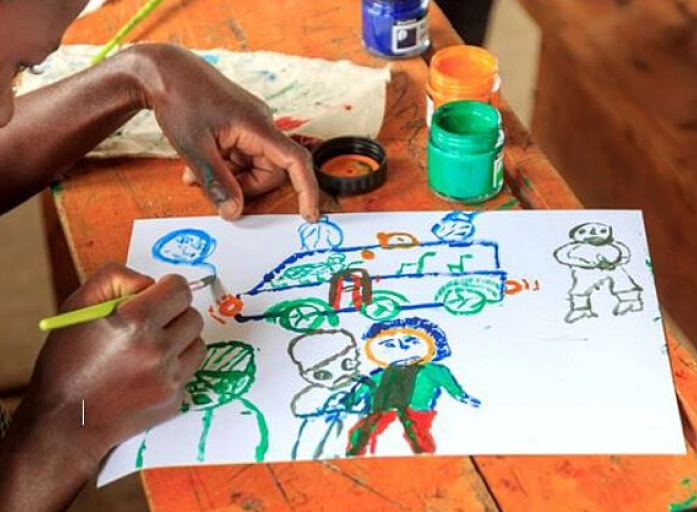
One example of this exchange are the so-called ‘painting conversations’, which enable a simplified form of communication between German and Rwandan primary schools. As children in both countries usually have only a limited knowledge of English, the exchange takes place via pictures on topics such as everyday life, dreams for the future and ideas about the other country. The resulting drawings are sent to the partner school and offer an interesting insight into the children’s lives.

Another focus is on early childhood development, which is not yet widespread in Rwanda but is becoming increasingly important. While there is a legal right to a place in a daycare centre in Germany, Rwanda often lacked the necessary structures in the past. A project was therefore launched in the Kirehe sector, in which twenty women were trained as mediators in a two-week course. They raise awareness in their communities about age-appropriate care and support the establishment of appropriate facilities.
Contact
Vocational schools and TVET institutions play a crucial role in equipping students with practical skills and providing career guidance. As part of the partnership between Rhineland-Palatinate and Rwanda, these institutions receive targeted support to enhance training conditions for young people.
Key measures include the construction of additional workshops for skills such as tailoring, carpentry, and metalworking, as well as the provision of materials for specialized training fields. In addition, rainwater cisterns and sanitary facilities are being built to improve the infrastructure of the schools and create a better overall learning environment.
This targeted support offers more students the opportunity to undergo practical training, significantly expanding their career prospects in the long term.

The partnership between Rhineland-Palatinate and Rwanda is actively committed to improving healthcare and promoting inclusive structures. The focus is not only on individual projects, but also on long-term impact and raising social awareness.
Health stations receive targeted support, for example through the provision of ambulances or medical equipment by partner organisations. In addition, there are initiatives to expand and renovate facilities for people with physical or mental disabilities. However, despite the construction of dormitories, classrooms, rainwater cisterns and accessible toilets, major challenges remain, particularly with regard to the ongoing costs of medication and doctor’s visits.

One example of targeted inclusion promotion is the SUGIRA network, which was founded in 2016 under the umbrella of Jumelage. It brings together 18 centres that care for children with disabilities in Rwanda. The network not only promotes exchange and cooperation with similar institutions in Rhineland-Palatinate, but also aims to strengthen inclusion and the range of services available to people with disabilities in Rwanda.
In order to support SUGIRA employees with more qualified knowledge, the Rhineland-Palatinate partnership launched a capacity-building programme in the summer of 2019. Various training courses covered topics that expand the expertise of employees and further advance inclusion work in Rwanda.
Despite this progress, inclusion remains a topic that receives little attention in Rwandan society. The partnership is committed to establishing inclusion as a matter of course – especially in schools, which have often not been inclusive in the past.
Contact
A central component of the partnership between Rhineland-Palatinate and Rwanda is the promotion of income-generating initiatives based on the principle of helping people to help themselves. The aim is to strengthen the economic independence of low-income families and open up long-term prospects for them.
Livestock breeding projects have been initiated in various regions of Rwanda as part of the cooperation. Families receive small animals such as goats or pigs, which they can use to provide for themselves and generate their own income by selling the animals or their products. In addition, materials for craft activities are provided, such as sewing machines, baking utensils or tools for manufacturing simple products. This creates a local source of income that helps to stabilise household finances.
These initiatives strengthen participants’ confidence in their own abilities and make an important contribution to reducing poverty and promoting economic participation.

Sport has the potential to promote individual strengths, create social bonds and enable social participation – regardless of gender, origin or personal circumstances. In the partnership between Rhineland-Palatinate and Rwanda, sport is therefore seen not only as a leisure activity, but also as an important tool for social development and equality.
Despite considerable progress in gender equality, young women in rural areas of Rwanda in particular continue to be disadvantaged. Family obligations and limited prospects often restrict their opportunities for development. To counteract this, the partnership focuses on empowerment measures designed to help women lead self-determined lives. Sport plays a key role in this by contributing to personal development as part of cultural education. Learning new skills not only promotes self-confidence, but also strengthens the sense of community and the demand for equality.
One outstanding example is the Rambura WFC women’s football club, which was founded in 2008 as part of the partnership between Rambura and Holzheim. The team made it to the top Rwandan national league – an extraordinary achievement for a team from a rural region. Another example of a project is ‘Sports4Peace’, in which teachers were trained to use sport specifically as a means of conflict resolution in the classroom.
Sport is for everyone – for every gender, every age group and every walk of life. It creates connections, promotes equality and provides a space for encounter, respect and cohesion.
Contact

To ensure the long-term impact of our projects, we invest in targeted training and capacity-building measures. These strengthen our partners’ ability to use new technologies effectively, support transition processes, and promote sustainable use through financing and business planning. In addition, we continuously qualify professionals, particularly in the social, educational, and municipal sectors, to embed professional practices and strengthen local processes over time.
Social sustainability is a core element of our work. We strengthen local structures, promote participation, and support the development of stable communities and networks. By building competencies, encouraging exchange, and closely involving our partners, we create a shared understanding that extends beyond the project duration and contributes to lasting social development.
Ecological sustainability is also gaining importance. We promote resource-efficient, locally appropriate solutions, raise awareness of sustainable resource use, and involve local stakeholders in measures such as reforestation, soil improvement, or waste reduction. Through training and participatory exchange, we foster a holistic understanding of how ecological considerations contribute to the long-term stability and effectiveness of projects.

