

Library
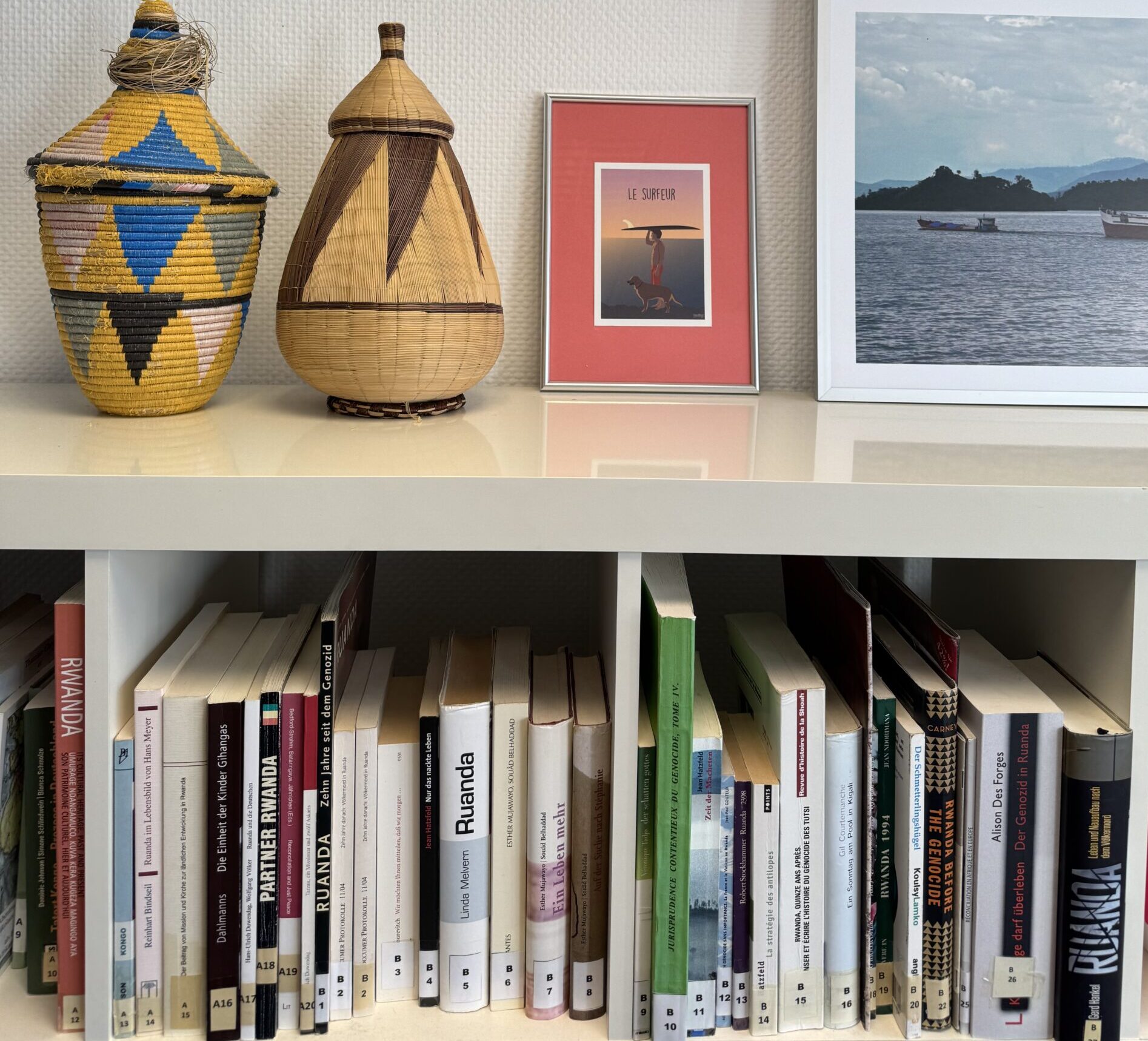
We have set up a small library in our office on the subject of Rwanda and the areas of development cooperation and colonialism. The selection includes a wide range of books that provide in-depth insights into the history, culture and political development of Rwanda and also address its historical relationship with Europe and the effects of the colonial era.
If you have any questions about the library or are interested in placing an order, please feel free to contact us by E-Mail. We are always happy to help and look forward to hearing from you!
Literature
Below you will find some references on the subject of Rwanda. The literature has been divided into different categories for easier navigation. Some books can be borrowed from our library (see above). You will also find further book and film reviews in the various issues of the Ruanda Revue.
History of Rwanda
Barahinyura, Shyirambere: 1973-1988 Le Général-Major Habyarimana – Quinze ans de tyrannie et de tartuferie au Rwanda. The author critically examines the Habyarimana regime. Éditions Izuba, Frankfurt am Main 1988.
Bindseil, Reinhart: Rwanda and Germany since the days of Richard Kandt = Le Rwanda et I’Allemagne depuis le temps de Richard Kandt: Encounters and shared paths. Historical outline of German-Rwandan relations with a biographical tribute to the former German imperial resident /Reinhart Blindseil. Reimer, Berlin 1988.
Bindseil, Reinhart: Rwanda in the life portrait of Hans Meyer. A biographical portrait, with diary entries from the land of a thousand hills, a presentation of the Kivu border dispute (1885-1910) as well as glimpses of the First World War and the end of German colonial presence, (1858-1929) Dietrich Reimer Verlag, Berlin 2003.
Brandstetter, Anna-Maria: Ruler over a thousand hills. Centralization processes in Rwanda in the 19th century Grab, Mainz after 1987
Calließ, Jörg (Ed.): Ten years later: Genocide in Rwanda – Ten Years After: Genocide in Rwanda. Documentation of a conference of the Protestant Academy Loccum from March 5-7, 2004. Conference contributions by various authors on the tenth anniversary of the genocide, GGP media on demand, Pößneck 2005
Dünkelsbühler, Gaspard: Notes from Rwanda. Private notes of a journey from Rwanda, private printing 1982.
Galabert, John Luc: Les enfants d´Imana. The author examines the socio-cultural history of Rwanda before colonization through the deconstruction of myths, emphasizing particularly the historical dimension of prejudices between the two ethnic groups Hutu and Tutsi, Èditions Izuba 2011.
Gatwa, Tharcisse; Rutinduka, Laurent: History of Christianity in Rwanda. This book reflects the universal dimension of the Church’s efforts in cooperation between ecumenical and Christian communities in Rwanda, Éditions CLÈ Yaoundé 2014.
Gottschalk, Sebastian; Hartmann, Heike; Hilden, Irene et al.: German Colonialism: Fragments of its history and present. Volume processes the German colonization operated in the late 19th century analogous to the exhibition of the same name in the German Historical Museum and looks at its contemporary aftereffects, German Historical Museum 2016.
Gourevitch, Philip: We Wish to Inform You That Tomorrow We Will Be Killed With Our Families – Reports from Rwanda. Standard work interviews with survivors – Gourevitch develops from stories of eyewitnesses and those affected, as well as through portraits of Rwandans, a moving picture of the events of the 1994 genocide, BvT Berliner Taschenbuch Verlags GmbH, Berlin 2008.
Johnson, Dominic; Schlindwein, Simone; Schmolze, Bianca: Crime Scene Congo: Trial in Germany. The crimes of the Rwandan militia FDLR and the attempt at legal processing. The book leads from the dock in a German courtroom to Rwanda and eastern Congo. It concerns the Hutu militia FDLR, in which the perpetrators of the 1994 Rwandan genocide have reorganized themselves. Their leaders operated from Germany, Christoph Links Verlag GmbH. Berlin 2016.
Klos, Stefani:
The contribution of mission and church to rural development in Rwanda
LIT-Verlag, Münster 1996.
König, Dieter
Erosion protection in agroforestry systems
Possibilities for limiting soil erosion in Rwanda’s small-scale farming landscape within the framework of site-appropriate land use systems (Mainzer geographische Studien; 37)
Geographical Institute of Johannes Gutenberg University, Mainz 1992.
Liebhafsky des Forges, Alison: Defeat is only bad news- Rwanda under Musinga 1896- 1930, the University Press of Wisconsin 2011.
Löber, Ulrich/Rickal, Elisabeth (Eds.): Rwanda Accompanying publication to the traveling exhibition of the same name at the Landesmuseum Koblenz Pfälz. Verl.-Anst., Koblenz 1991.
Misago Kaniba, Celestin; Van Pee, Lode: Rwanda its cultural Heritage. Past and present. Rwanda’s history, culture and society. Then and now, Institute des Musees Nationaux du Rwanda (I.M.N.R) 2008.
Schäfer, Ernst / Erdel, Gusti: Tracing in Rwanda. Adventurous travel reports of Nikolaus Illerich from Miesenheim. His life and work as Brother Anelmus with the Africa missionaries White Fathers, n.d.
Werle, Otmar: Rwanda : A regional portrait / Otmar Werle ; Karl-Heinz Weichert. Ed.: Landesbildstelle Rheinland-Pfalz. – Koblenz: Görres-Verl., 1987. – 164 p. : numerous ill. (partly col.), graph. representations, maps.
Politics
Barahinyura, Shyirambere: 1973-1988 Le Général-Major Habyarimana – Quinze ans de tyrannie et de tartuferie au Rwanda. The author critically examines the Habyarimana regime. Éditions Izuba, Frankfurt am Main 1988.
Bindseil, Reinhart: Rwanda and Germany since the days of Richard Kandt = Le Rwanda et I’Allemagne depuis le temps de Richard Kandt: Encounters and shared paths. Historical outline of German-Rwandan relations with a biographical tribute to the former German imperial resident /Reinhart Blindseil. Reimer, Berlin 1988.
Bindseil, Reinhart: Rwanda in the life portrait of Hans Meyer. A biographical portrait, with diary entries from the land of a thousand hills, a presentation of the Kivu border dispute (1885-1910) as well as glimpses of the First World War and the end of German colonial presence, (1858-1929) Dietrich Reimer Verlag, Berlin 2003.
Brandstetter, Anna-Maria: Ruler over a thousand hills. Centralization processes in Rwanda in the 19th century Grab, Mainz after 1987
Calließ, Jörg (Ed.): Ten years later: Genocide in Rwanda – Ten Years After: Genocide in Rwanda. Documentation of a conference of the Protestant Academy Loccum from March 5-7, 2004. Conference contributions by various authors on the tenth anniversary of the genocide, GGP media on demand, Pößneck 2005
Dünkelsbühler, Gaspard: Notes from Rwanda. Private notes of a journey from Rwanda, private printing 1982.
Galabert, John Luc: Les enfants d´Imana. The author examines the socio-cultural history of Rwanda before colonization through the deconstruction of myths, emphasizing particularly the historical dimension of prejudices between the two ethnic groups Hutu and Tutsi, Èditions Izuba 2011.
Gatwa, Tharcisse; Rutinduka, Laurent: History of Christianity in Rwanda. This book reflects the universal dimension of the Church’s efforts in cooperation between ecumenical and Christian communities in Rwanda, Éditions CLÈ Yaoundé 2014.
Gottschalk, Sebastian; Hartmann, Heike; Hilden, Irene et al.: German Colonialism: Fragments of its history and present. Volume processes the German colonization operated in the late 19th century analogous to the exhibition of the same name in the German Historical Museum and looks at its contemporary aftereffects, German Historical Museum 2016.
Gourevitch, Philip: We Wish to Inform You That Tomorrow We Will Be Killed With Our Families – Reports from Rwanda. Standard work interviews with survivors – Gourevitch develops from stories of eyewitnesses and those affected, as well as through portraits of Rwandans, a moving picture of the events of the 1994 genocide, BvT Berliner Taschenbuch Verlags GmbH, Berlin 2008.
Johnson, Dominic; Schlindwein, Simone; Schmolze, Bianca: Crime Scene Congo: Trial in Germany. The crimes of the Rwandan militia FDLR and the attempt at legal processing. The book leads from the dock in a German courtroom to Rwanda and eastern Congo. It concerns the Hutu militia FDLR, in which the perpetrators of the 1994 Rwandan genocide have reorganized themselves. Their leaders operated from Germany, Christoph Links Verlag GmbH. Berlin 2016.
Klos, Stefani:
The contribution of mission and church to rural development in Rwanda
LIT-Verlag, Münster 1996.
König, Dieter
Erosion protection in agroforestry systems
Possibilities for limiting soil erosion in Rwanda’s small-scale farming landscape within the framework of site-appropriate land use systems (Mainzer geographische Studien; 37)
Geographical Institute of Johannes Gutenberg University, Mainz 1992.
Liebhafsky des Forges, Alison: Defeat is only bad news- Rwanda under Musinga 1896- 1930, the University Press of Wisconsin 2011.
Löber, Ulrich/Rickal, Elisabeth (Eds.): Rwanda Accompanying publication to the traveling exhibition of the same name at the Landesmuseum Koblenz Pfälz. Verl.-Anst., Koblenz 1991.
Misago Kaniba, Celestin; Van Pee, Lode: Rwanda its cultural Heritage. Past and present. Rwanda’s history, culture and society. Then and now, Institute des Musees Nationaux du Rwanda (I.M.N.R) 2008.
Schäfer, Ernst / Erdel, Gusti: Tracing in Rwanda. Adventurous travel reports of Nikolaus Illerich from Miesenheim. His life and work as Brother Anelmus with the Africa missionaries White Fathers, n.d.
Werle, Otmar: Rwanda : A regional portrait / Otmar Werle ; Karl-Heinz Weichert. Ed.: Landesbildstelle Rheinland-Pfalz. – Koblenz: Görres-Verl., 1987. – 164 p. : numerous ill. (partly col.), graph. representations, maps.
Carstens, Karl: Visit of the President of the Republic of Rwanda (March 25-April 3, 1984) : Speech at a dinner in honor of President Major General Juvenal Habyarimana at the Federal President’s residence (March 27, 1984) / Karl Carstens. In: Carstens, Karl: Speeches and Interviews. [Bonn], 1984. 486 p.. ; p. 277 – 280.
War Events 1998: Data and trends of wars and armed conflicts / Ed. by Thomas Rabehl. – Opladen : Leske + Budrich, 1999. – 232 p.
War Events 1999: Data and trends of wars and armed conflicts / Ed. by Thomas Rabehl. – Opladen : Leske + Budrich, 2000. – 283 p.
War Events 2000: Data and trends of wars and armed conflicts / Ed. by Thomas Rabehl and Wolfgang Schreiber. – Opladen : Leske + Budrich, 2001. – 285 p.
War Events 2001: Data and trends of wars and armed conflicts. With special contribution on “War economies and long wars” / Ed. by Wolfgang Schreiber. – Opladen : Leske + Budrich, 2002. – 288 p.
War Events 2002: Data and trends of wars and armed conflicts. With special contribution on “Terrorism and war events” / Ed. by Wolfgang Schreiber. – Opladen : Leske + Budrich, 2003. – 272 p.
Heinsch, Robert: The further development of international humanitarian law by the criminal tribunals for the former Yugoslavia and Rwanda : On the significance of international court decisions as a legal source of international criminal law / Robert Heinsch. – Berlin : Berliner Wissenschafts-Verlag, 2007. – 413 p. – (Bochumer Schriften zur Friedenssicherung und zum humanitären Völkerrecht ; Vol. 57).
Muyombano, Célestin: Rwanda : The historical causes of the civil war / Célestin Muyombano. – Stuttgart : Naglschmid, 1995. – 104 p. : ill., maps. – (VSN profund ; 1).
Reyntjens, Filip: Political Governance in Post-Genocide Rwanda. Reyntjens analyzes Rwanda’s political leadership since the genocide and highlights the rise of the authoritarian Rwanda Patriotic Front. Cambridge University Press, 2013.
Scheel, Walter: State visit of the President of the Republic of Rwanda : Speech at a luncheon in honor of President Juvenal Habyarimana in Bonn (March 14, 1977) / Walter Scheel. In: Walter Scheel / Ed. by Press and Information Office of the Federal Government. – 1977/ Walter Scheel. In: Walter Scheel / Ed. by Press and Information Office of the Federal Government. – (3).: July 1, 1976- June 30, 1977. 413 p..; p. 218- 221.
Strizek, Helmut: Gifted colonies: Rwanda and Burundi under German rule / Helmut Strizek. – 1st ed. – Stuttgart: Links, 2006. – 224 p. : ill.
Waal, Alex de: Rwanda Humanitarian aid and the limits of neutrality. In: The new interventionism Bonn 1996.
Ethnology
Barahinyura, Shyirambere: 1973-1988 Le Général-Major Habyarimana – Quinze ans de tyrannie et de tartuferie au Rwanda. The author critically examines the Habyarimana regime. Éditions Izuba, Frankfurt am Main 1988.
Bindseil, Reinhart: Rwanda and Germany since the days of Richard Kandt = Le Rwanda et I’Allemagne depuis le temps de Richard Kandt: Encounters and shared paths. Historical outline of German-Rwandan relations with a biographical tribute to the former German imperial resident /Reinhart Blindseil. Reimer, Berlin 1988.
Bindseil, Reinhart: Rwanda in the life portrait of Hans Meyer. A biographical portrait, with diary entries from the land of a thousand hills, a presentation of the Kivu border dispute (1885-1910) as well as glimpses of the First World War and the end of German colonial presence, (1858-1929) Dietrich Reimer Verlag, Berlin 2003.
Brandstetter, Anna-Maria: Ruler over a thousand hills. Centralization processes in Rwanda in the 19th century Grab, Mainz after 1987
Calließ, Jörg (Ed.): Ten years later: Genocide in Rwanda – Ten Years After: Genocide in Rwanda. Documentation of a conference of the Protestant Academy Loccum from March 5-7, 2004. Conference contributions by various authors on the tenth anniversary of the genocide, GGP media on demand, Pößneck 2005
Dünkelsbühler, Gaspard: Notes from Rwanda. Private notes of a journey from Rwanda, private printing 1982.
Galabert, John Luc: Les enfants d´Imana. The author examines the socio-cultural history of Rwanda before colonization through the deconstruction of myths, emphasizing particularly the historical dimension of prejudices between the two ethnic groups Hutu and Tutsi, Èditions Izuba 2011.
Gatwa, Tharcisse; Rutinduka, Laurent: History of Christianity in Rwanda. This book reflects the universal dimension of the Church’s efforts in cooperation between ecumenical and Christian communities in Rwanda, Éditions CLÈ Yaoundé 2014.
Gottschalk, Sebastian; Hartmann, Heike; Hilden, Irene et al.: German Colonialism: Fragments of its history and present. Volume processes the German colonization operated in the late 19th century analogous to the exhibition of the same name in the German Historical Museum and looks at its contemporary aftereffects, German Historical Museum 2016.
Gourevitch, Philip: We Wish to Inform You That Tomorrow We Will Be Killed With Our Families – Reports from Rwanda. Standard work interviews with survivors – Gourevitch develops from stories of eyewitnesses and those affected, as well as through portraits of Rwandans, a moving picture of the events of the 1994 genocide, BvT Berliner Taschenbuch Verlags GmbH, Berlin 2008.
Johnson, Dominic; Schlindwein, Simone; Schmolze, Bianca: Crime Scene Congo: Trial in Germany. The crimes of the Rwandan militia FDLR and the attempt at legal processing. The book leads from the dock in a German courtroom to Rwanda and eastern Congo. It concerns the Hutu militia FDLR, in which the perpetrators of the 1994 Rwandan genocide have reorganized themselves. Their leaders operated from Germany, Christoph Links Verlag GmbH. Berlin 2016.
Klos, Stefani:
The contribution of mission and church to rural development in Rwanda
LIT-Verlag, Münster 1996.
König, Dieter
Erosion protection in agroforestry systems
Possibilities for limiting soil erosion in Rwanda’s small-scale farming landscape within the framework of site-appropriate land use systems (Mainzer geographische Studien; 37)
Geographical Institute of Johannes Gutenberg University, Mainz 1992.
Liebhafsky des Forges, Alison: Defeat is only bad news- Rwanda under Musinga 1896- 1930, the University Press of Wisconsin 2011.
Löber, Ulrich/Rickal, Elisabeth (Eds.): Rwanda Accompanying publication to the traveling exhibition of the same name at the Landesmuseum Koblenz Pfälz. Verl.-Anst., Koblenz 1991.
Misago Kaniba, Celestin; Van Pee, Lode: Rwanda its cultural Heritage. Past and present. Rwanda’s history, culture and society. Then and now, Institute des Musees Nationaux du Rwanda (I.M.N.R) 2008.
Schäfer, Ernst / Erdel, Gusti: Tracing in Rwanda. Adventurous travel reports of Nikolaus Illerich from Miesenheim. His life and work as Brother Anelmus with the Africa missionaries White Fathers, n.d.
Werle, Otmar: Rwanda : A regional portrait / Otmar Werle ; Karl-Heinz Weichert. Ed.: Landesbildstelle Rheinland-Pfalz. – Koblenz: Görres-Verl., 1987. – 164 p. : numerous ill. (partly col.), graph. representations, maps.
Carstens, Karl: Visit of the President of the Republic of Rwanda (March 25-April 3, 1984) : Speech at a dinner in honor of President Major General Juvenal Habyarimana at the Federal President’s residence (March 27, 1984) / Karl Carstens. In: Carstens, Karl: Speeches and Interviews. [Bonn], 1984. 486 p.. ; p. 277 – 280.
War Events 1998: Data and trends of wars and armed conflicts / Ed. by Thomas Rabehl. – Opladen : Leske + Budrich, 1999. – 232 p.
War Events 1999: Data and trends of wars and armed conflicts / Ed. by Thomas Rabehl. – Opladen : Leske + Budrich, 2000. – 283 p.
War Events 2000: Data and trends of wars and armed conflicts / Ed. by Thomas Rabehl and Wolfgang Schreiber. – Opladen : Leske + Budrich, 2001. – 285 p.
War Events 2001: Data and trends of wars and armed conflicts. With special contribution on “War economies and long wars” / Ed. by Wolfgang Schreiber. – Opladen : Leske + Budrich, 2002. – 288 p.
War Events 2002: Data and trends of wars and armed conflicts. With special contribution on “Terrorism and war events” / Ed. by Wolfgang Schreiber. – Opladen : Leske + Budrich, 2003. – 272 p.
Heinsch, Robert: The further development of international humanitarian law by the criminal tribunals for the former Yugoslavia and Rwanda : On the significance of international court decisions as a legal source of international criminal law / Robert Heinsch. – Berlin : Berliner Wissenschafts-Verlag, 2007. – 413 p. – (Bochumer Schriften zur Friedenssicherung und zum humanitären Völkerrecht ; Vol. 57).
Muyombano, Célestin: Rwanda : The historical causes of the civil war / Célestin Muyombano. – Stuttgart : Naglschmid, 1995. – 104 p. : ill., maps. – (VSN profund ; 1).
Reyntjens, Filip: Political Governance in Post-Genocide Rwanda. Reyntjens analyzes Rwanda’s political leadership since the genocide and highlights the rise of the authoritarian Rwanda Patriotic Front. Cambridge University Press, 2013.
Scheel, Walter: State visit of the President of the Republic of Rwanda : Speech at a luncheon in honor of President Juvenal Habyarimana in Bonn (March 14, 1977) / Walter Scheel. In: Walter Scheel / Ed. by Press and Information Office of the Federal Government. – 1977/ Walter Scheel. In: Walter Scheel / Ed. by Press and Information Office of the Federal Government. – (3).: July 1, 1976- June 30, 1977. 413 p..; p. 218- 221.
Strizek, Helmut: Gifted colonies: Rwanda and Burundi under German rule / Helmut Strizek. – 1st ed. – Stuttgart: Links, 2006. – 224 p. : ill.
Waal, Alex de: Rwanda Humanitarian aid and the limits of neutrality. In: The new interventionism Bonn 1996.
Isoko: What news?. About life in Rwanda / ISOKO (Ed.). – Frankfurt/Main : Verl. für Interkulturelle Kommunikation, 1987. – 447 p. : ill. (partly col.), graph. representations, 2 maps.
Asche, Helmut: Rwanda. The production of an ethnic drama (Focus Afrika; 4) Institut für Afrika-Kunde, Hamburg 1995.
Burckhardt, Gisela: Women in the urban informal sector in Rwanda. Hamburger Beiträge zur Afrika-Kunde; 47)Institut für Afrika-Kunde, Hamburg 1995.
Dahlmanns, Erika: The unity of Gihanga’s children. Cultural dynamics and political thought patterns that help in coming to terms with the past are examined by Dahlmanns. Against this background, she looks at post-genocidal Rwanda and deals with cultural transformations, interpretive patterns as well as historical fictions, Wilhelm Fink Verlag 2017.
Fein, Alice: Africa images in the imagination of German youth – An analysis of student-produced images of Rwanda. Master’s thesis for obtaining the academic degree M.Ed. at the Geographical Institute of Johannes Gutenberg University Mainz, 2017.
Kandt, Richard: Caput Nili. A sentimental journey to the sources of the Nile. Landesmuseum, Koblenz 1991.
Marzi, Hiltrud: Age in Africa. Tradition and change. A documentation of the traveling exhibition of the same name by the Institute for Ethology and African Studies of Johannes Gutenberg University. Druckerei und Verlag Gebr. Kügler GmbH, Ingelheim 2002
Pädagogisches Zentrum Rheinland-Pfalz (Ed.): Everyday life in Rwanda. 10 transparencies, PZ-Information 6/97. Pädagogisches Zentrum Rheinland-Pfalz, Bad Kreuznach 1997
Carr, Rosamond H./Halsey, Ann H.: Land of a thousand hills. A life in Africa. München 2001 (Heyne Taschenbuch)
Genocide
Barahinyura, Shyirambere: 1973-1988 Le Général-Major Habyarimana – Quinze ans de tyrannie et de tartuferie au Rwanda. The author critically examines the Habyarimana regime. Éditions Izuba, Frankfurt am Main 1988.
Bindseil, Reinhart: Rwanda and Germany since the days of Richard Kandt = Le Rwanda et I’Allemagne depuis le temps de Richard Kandt: Encounters and shared paths. Historical outline of German-Rwandan relations with a biographical tribute to the former German imperial resident /Reinhart Blindseil. Reimer, Berlin 1988.
Bindseil, Reinhart: Rwanda in the life portrait of Hans Meyer. A biographical portrait, with diary entries from the land of a thousand hills, a presentation of the Kivu border dispute (1885-1910) as well as glimpses of the First World War and the end of German colonial presence, (1858-1929) Dietrich Reimer Verlag, Berlin 2003.
Brandstetter, Anna-Maria: Ruler over a thousand hills. Centralization processes in Rwanda in the 19th century Grab, Mainz after 1987
Calließ, Jörg (Ed.): Ten years later: Genocide in Rwanda – Ten Years After: Genocide in Rwanda. Documentation of a conference of the Protestant Academy Loccum from March 5-7, 2004. Conference contributions by various authors on the tenth anniversary of the genocide, GGP media on demand, Pößneck 2005
Dünkelsbühler, Gaspard: Notes from Rwanda. Private notes of a journey from Rwanda, private printing 1982.
Galabert, John Luc: Les enfants d´Imana. The author examines the socio-cultural history of Rwanda before colonization through the deconstruction of myths, emphasizing particularly the historical dimension of prejudices between the two ethnic groups Hutu and Tutsi, Èditions Izuba 2011.
Gatwa, Tharcisse; Rutinduka, Laurent: History of Christianity in Rwanda. This book reflects the universal dimension of the Church’s efforts in cooperation between ecumenical and Christian communities in Rwanda, Éditions CLÈ Yaoundé 2014.
Gottschalk, Sebastian; Hartmann, Heike; Hilden, Irene et al.: German Colonialism: Fragments of its history and present. Volume processes the German colonization operated in the late 19th century analogous to the exhibition of the same name in the German Historical Museum and looks at its contemporary aftereffects, German Historical Museum 2016.
Gourevitch, Philip: We Wish to Inform You That Tomorrow We Will Be Killed With Our Families – Reports from Rwanda. Standard work interviews with survivors – Gourevitch develops from stories of eyewitnesses and those affected, as well as through portraits of Rwandans, a moving picture of the events of the 1994 genocide, BvT Berliner Taschenbuch Verlags GmbH, Berlin 2008.
Johnson, Dominic; Schlindwein, Simone; Schmolze, Bianca: Crime Scene Congo: Trial in Germany. The crimes of the Rwandan militia FDLR and the attempt at legal processing. The book leads from the dock in a German courtroom to Rwanda and eastern Congo. It concerns the Hutu militia FDLR, in which the perpetrators of the 1994 Rwandan genocide have reorganized themselves. Their leaders operated from Germany, Christoph Links Verlag GmbH. Berlin 2016.
Klos, Stefani:
The contribution of mission and church to rural development in Rwanda
LIT-Verlag, Münster 1996.
König, Dieter
Erosion protection in agroforestry systems
Possibilities for limiting soil erosion in Rwanda’s small-scale farming landscape within the framework of site-appropriate land use systems (Mainzer geographische Studien; 37)
Geographical Institute of Johannes Gutenberg University, Mainz 1992.
Liebhafsky des Forges, Alison: Defeat is only bad news- Rwanda under Musinga 1896- 1930, the University Press of Wisconsin 2011.
Löber, Ulrich/Rickal, Elisabeth (Eds.): Rwanda Accompanying publication to the traveling exhibition of the same name at the Landesmuseum Koblenz Pfälz. Verl.-Anst., Koblenz 1991.
Misago Kaniba, Celestin; Van Pee, Lode: Rwanda its cultural Heritage. Past and present. Rwanda’s history, culture and society. Then and now, Institute des Musees Nationaux du Rwanda (I.M.N.R) 2008.
Schäfer, Ernst / Erdel, Gusti: Tracing in Rwanda. Adventurous travel reports of Nikolaus Illerich from Miesenheim. His life and work as Brother Anelmus with the Africa missionaries White Fathers, n.d.
Werle, Otmar: Rwanda : A regional portrait / Otmar Werle ; Karl-Heinz Weichert. Ed.: Landesbildstelle Rheinland-Pfalz. – Koblenz: Görres-Verl., 1987. – 164 p. : numerous ill. (partly col.), graph. representations, maps.
Carstens, Karl: Visit of the President of the Republic of Rwanda (March 25-April 3, 1984) : Speech at a dinner in honor of President Major General Juvenal Habyarimana at the Federal President’s residence (March 27, 1984) / Karl Carstens. In: Carstens, Karl: Speeches and Interviews. [Bonn], 1984. 486 p.. ; p. 277 – 280.
War Events 1998: Data and trends of wars and armed conflicts / Ed. by Thomas Rabehl. – Opladen : Leske + Budrich, 1999. – 232 p.
War Events 1999: Data and trends of wars and armed conflicts / Ed. by Thomas Rabehl. – Opladen : Leske + Budrich, 2000. – 283 p.
War Events 2000: Data and trends of wars and armed conflicts / Ed. by Thomas Rabehl and Wolfgang Schreiber. – Opladen : Leske + Budrich, 2001. – 285 p.
War Events 2001: Data and trends of wars and armed conflicts. With special contribution on “War economies and long wars” / Ed. by Wolfgang Schreiber. – Opladen : Leske + Budrich, 2002. – 288 p.
War Events 2002: Data and trends of wars and armed conflicts. With special contribution on “Terrorism and war events” / Ed. by Wolfgang Schreiber. – Opladen : Leske + Budrich, 2003. – 272 p.
Heinsch, Robert: The further development of international humanitarian law by the criminal tribunals for the former Yugoslavia and Rwanda : On the significance of international court decisions as a legal source of international criminal law / Robert Heinsch. – Berlin : Berliner Wissenschafts-Verlag, 2007. – 413 p. – (Bochumer Schriften zur Friedenssicherung und zum humanitären Völkerrecht ; Vol. 57).
Muyombano, Célestin: Rwanda : The historical causes of the civil war / Célestin Muyombano. – Stuttgart : Naglschmid, 1995. – 104 p. : ill., maps. – (VSN profund ; 1).
Reyntjens, Filip: Political Governance in Post-Genocide Rwanda. Reyntjens analyzes Rwanda’s political leadership since the genocide and highlights the rise of the authoritarian Rwanda Patriotic Front. Cambridge University Press, 2013.
Scheel, Walter: State visit of the President of the Republic of Rwanda : Speech at a luncheon in honor of President Juvenal Habyarimana in Bonn (March 14, 1977) / Walter Scheel. In: Walter Scheel / Ed. by Press and Information Office of the Federal Government. – 1977/ Walter Scheel. In: Walter Scheel / Ed. by Press and Information Office of the Federal Government. – (3).: July 1, 1976- June 30, 1977. 413 p..; p. 218- 221.
Strizek, Helmut: Gifted colonies: Rwanda and Burundi under German rule / Helmut Strizek. – 1st ed. – Stuttgart: Links, 2006. – 224 p. : ill.
Waal, Alex de: Rwanda Humanitarian aid and the limits of neutrality. In: The new interventionism Bonn 1996.
Isoko: What news?. About life in Rwanda / ISOKO (Ed.). – Frankfurt/Main : Verl. für Interkulturelle Kommunikation, 1987. – 447 p. : ill. (partly col.), graph. representations, 2 maps.
Asche, Helmut: Rwanda. The production of an ethnic drama (Focus Afrika; 4) Institut für Afrika-Kunde, Hamburg 1995.
Burckhardt, Gisela: Women in the urban informal sector in Rwanda. Hamburger Beiträge zur Afrika-Kunde; 47)Institut für Afrika-Kunde, Hamburg 1995.
Dahlmanns, Erika: The unity of Gihanga’s children. Cultural dynamics and political thought patterns that help in coming to terms with the past are examined by Dahlmanns. Against this background, she looks at post-genocidal Rwanda and deals with cultural transformations, interpretive patterns as well as historical fictions, Wilhelm Fink Verlag 2017.
Fein, Alice: Africa images in the imagination of German youth – An analysis of student-produced images of Rwanda. Master’s thesis for obtaining the academic degree M.Ed. at the Geographical Institute of Johannes Gutenberg University Mainz, 2017.
Kandt, Richard: Caput Nili. A sentimental journey to the sources of the Nile. Landesmuseum, Koblenz 1991.
Marzi, Hiltrud: Age in Africa. Tradition and change. A documentation of the traveling exhibition of the same name by the Institute for Ethology and African Studies of Johannes Gutenberg University. Druckerei und Verlag Gebr. Kügler GmbH, Ingelheim 2002
Pädagogisches Zentrum Rheinland-Pfalz (Ed.): Everyday life in Rwanda. 10 transparencies, PZ-Information 6/97. Pädagogisches Zentrum Rheinland-Pfalz, Bad Kreuznach 1997
Carr, Rosamond H./Halsey, Ann H.: Land of a thousand hills. A life in Africa. München 2001 (Heyne Taschenbuch)
Bayle, Reine-Marguerite: Genocide From contempt to barbarism Elefanten Press/C. Bertelsmann Jugendbuch Verlag, München 2001.
Behrendt, Urs P.: The prosecution of genocide in Rwanda by international and national courts : Also a contribution to the content and function of the universality principle in the prosecution of crimes under international law / Urs P. Behrendt. – Berlin : Berliner Wissenschafts-Verlag, 2005. – XV, 383 p.
Bensoussan, Georges: Rwanda fifteen years later. Thinking and writing the history of the Tutsi genocide. The book reports on the time of the genocide in Rwanda as well as the period after. Reports, memories, comparisons are included, Revue d’histoire de la Shoah, N° 190 Janvier/Juin 2009.
Brunhold, Georg; König, Andrea; Ulutoncok Guenay: Did nothing, saw nothing, don’t talk about it – Rwanda – Ten years after the genocide. Reports and analyses. Picture book with reports and analyses by internationally renowned authors who, according to the state of knowledge in 2004, attempt an explanation of the causes and consequences of the genocide, Schmidt von Schwind Verlag, Köln 2004.
Calließ, Jörg (Ed.): Ten years later: Genocide in Rwanda – Ten Years After: Genocide in Rwanda. Documentation of a conference of the Protestant Academy Loccum from March 5-7, 2004. Conference contributions by various authors on the tenth anniversary of the genocide, GGP media on demand, Pößneck 2005.
Carney, J.J: Rwanda before the genocide. Between 1920 and 1994, the Catholic Church was Rwanda’s dominant social and religious institution. In recent years, the Church has been criticized for its alleged complicity in ethnic discourse and political corruption that culminated in the 1994 genocide. Rwanda Before the Genocide focuses on the critical decade from 1952 to 1962, when Hutu and Tutsi identities were politicized and essentialized and associated with potential violence, Oxford University Press 2014.
Chrismon: chrismon – Eight murders. Or more. Forgiveness by murderers of the genocide, The Protestant Magazine 2014.Courtemanche, Gil: A Sunday at the pool in Kigali Verlag Kiepenheuer & Witsch, Köln 2004.
Dallaire, Roméo: Shake hands with the devil : The complicity of the world community in the genocide in Rwanda / Roméo Dallaire. With collaboration by Brent Beardsley. From English by Andreas Simon dos Santos. With an afterword by Dominic Johnson. – German first edition, 2nd ed. – Frankfurt am Main : Zweitausendeins, 2005. – 650 p. : maps. EST: Shake hands with the devil
Decker, Rudolf: Rwanda : Death and hope in the land of a thousand hills. Responsibility before God and people / Rudolf Decker. – [Extended new ed.] – Neuhausen-Stuttgart : Hänssler, 1998. – 196 p. : maps. – (Encounters and impressions ; 1)
Decker, Rudolf: In the heart of Africa : Hutu and Tutsi between destruction and reconciliation. Responsibility before God and people / Rudolf Decker. – Neuhausen-Stuttgart : Hänssler, 1998. – 198 p. : maps. – (Encounters and impressions ; 2)
Des Forges, Alison: No witness must survive The genocide in Rwanda Hamburger Edition, Hamburg 2002.
FES, pay christi, NAD: Réconciliation en Afrique et en Europe. Reconciliation processes, n.d. 2004.
Gourevitch, Philip: We wish to inform you that tomorrow we will be killed with our families Reports from Rwanda, Berlin Verlag, Berlin 1999.
Hatzfeld, Jean: Only bare life : Reports from the swamps of Rwanda / Jean Hatzfeld.. From French by Karl-Udo Bigott. – Gießen : Haland & Wirth, 2004. – 251 p. : ill., maps. EST: Dans le nu de la vie
Hatzfeld, Jean: Time of the machetes : Conversations with the perpetrators of genocide in Rwanda /Jean Hatzfeld. From French by Karl-Udo Bigott. With an afterword by Hans-Jürgen Wirth. – Gießen : Haland & Wirth im Psychosozial-Verl., 2004. – 314 p. : maps. EST: Une saison de machettes
Hänssler, Friedrich (Ed.): Rwanda Death and hope in the land of a thousand hills. A narrative Hänssler, Stuttgart 1995.
Hankel, Gerd: Rwanda. Life and reconstruction after genocide. How history is made and becomes official truth. After the genocide, Rwanda is considered a model for coming to terms with the past and a showcase for development. Nevertheless, doubts are warranted whether this impression corresponds to the facts, zu Klampen Verlag 2016.
IBUKA: Survivors as Actors of Change for Peace and Reconciliation – Intermediaries and Beneficiaries of IBUKA tell their Stories of Change. Stories by genocide survivors, IBUKA 2013.
Jansen, Hanna: Over a thousand hills I wander with you Thienemann Verlag GmbH, Stuttgart 2002.
Johnson, Dominic: Rwanda Anatomy of a genocide In: The future of human rights Reinbek bei Hamburg 1998.
Jonathan Torgovnik: Children of war- Rwanda and the unknown consequences of genocide Stories and interviews about the struggle for existence of Rwandan women raising children of rape, zweitausendeins 2009.
Lamko, Koulsy: The butterfly hill. Dr. Koulsy Lamko, born 1959 in Chad, is a poet, playwright, university lecturer. This is his eloquent, richly visual and shocking novel about the genocide in Rwanda, angkor Verlag 2000.
Mann, Michael: The dark side of democracy : A theory of ethnic cleansing / Michael Mann. From English by Werner Roller. – 1st ed. – Hamburg : Hamburger Edition, 2007. – 861 p. : maps. EST: The dark side of democracy
Melvern, Linda:Rwanda : The genocide and the involvement of the Western world /Linda Melvern. From English by Anne Emmert, Ursula Pesch, Thomas Pfeiffer and Karin Schuler. – Kreuzlingen; München : Diederichs, 2004. – 384 p.EST: Conspiracy to Murder
Mujawayo, Esther; Belhaddad, Souad: SurVivantes (Original edition of “One more life”). The survivor Esther Mujawayo, who lost her husband and many family members in the genocide, describes her tragic story and her will to help the countless traumatized widows and children, Éditions de l´aube 2004.
Mujawayo, Ester:In search of Stéphanie : Rwanda between reconciliation and refusal /Ester Mujawayo ; Souâd Belhaddad. From French by Jutta Himmelreich. -Wuppertal : Hammer, 2007. – 268 p. EST: La fleur de Stéphanie
Mujawayo, Esther: One more life : Ten years after the genocide in Rwanda /Esther Mujawayo ; Souâd Belhaddad. From French by Jutta Himmelreich. -Wuppertal :Hammer, 2005. – 337 p. EST: Survivantes
Ndorimana, Jean: Rwanda 1994, Edizioni Vivere in Roma 2003.
Oosterom, Wiljo Woodi: Stars of Rwanda.The marks the genocide in Rwanda left will not be wiped out for a long time to come. Thousands of children have been irrevocably damaged, both physically and mentally, by this nightmare. Wiljo Woodi Oosterom took pity on them and gave them in this book the opportunity to tell about their horrifying experiences, their courage, and their hopes for the future, Silent Work Foundation 2004.
Rwanda: The hidden violence: “Disappearances” and killings continue / Amnesty International. – n.p., 1998. – 32 p. EST: Rwanda – the hidden violence
Rwanda: Ten years since the genocide. Reports and analyses / Ed.: Georg Brunold ; Andrea König ; Cuenay Ulutunçok. Authors: Peter Baumgartner …. – 1st ed. – Köln : Schmidt von Schwind, 2004. – 102 p. : predominantly ill., maps.
Rwanda: Back to life. A documentation / With photos by Thomas Lohnes and texts by Regina Karasch and Rainer Lang. – Stuttgart : Deutsches Nationalkomitee des Lutherischen Weltbundes, 2002. – 64 p. : numerous ill.
Rwanda – the path to genocide: Prehistory – course – interpretation / Leonhard Harding (Ed.). – Hamburg : LIT, 1998. – IV, 240 p. : maps. – (Studies in African History ; 20)
Rusesabagina, Paul: An ordinary man : The true story behind >Hotel Rwanda< / Paul Rusesabagina with Tom Zoellner. German by Hainer Kober. -Berlin : Berlin-Verl., 2006. – 252 p. : 1 map. EST: An ordinary man
Rutayisire; Antoine: And yet I reach out my hand to you. Rwanda between genocide and reconciliation Brendow-Verlag, 2001.
Schilling, Sandrine: Against forgetting : Justice, truth-finding and reconciliation after the genocide in Rwanda through mechanisms of transitional justice: Gacaca courts / Sandrine Schilling. – Bern ; Berlin ; Bruxelles ; Frankfurt am Main ; New York ; Oxford ; Wien : Lang, 2005. – 399 p. Also: Zürich, Univ., Diss.,2004.
Spitz, Stefanie: UN – Peacekeeping reforms : The genocide in Rwanda and the lessons of the United Nations / Stefanie Spitz. – Saarbrücken : VDM Verlag Dr. Müller, 2007. – 115 p.
Stockhammer, Robert: Rwanda: Writing about another genocide / Robert Stockhammer. – Original edition, 1st ed. – Frankfurt am Main : Suhrkamp, 2005. – 287 p. – (Edition Suhrkamp ; 2398).
Tadjo, Véronique: The shadow of God Journey to the end of Rwanda Peter Hammer Verlag, Wuppertal 2001.
Ten years later: Genocide in Rwanda = Ten years after: Genocide in Rwanda. Documentation of a conference of the Protestant Academy Loccum from March 5 to 7, 2004 / Ed. / Ed. Jörg Calließ. – 1st ed. – Evangelische Akademie Loccum : Rehburg- Loccum, 2005. – 236 p. – (Loccumer Protokolle ; 11/04).
Development Cooperation
Barahinyura, Shyirambere: 1973-1988 Le Général-Major Habyarimana – Quinze ans de tyrannie et de tartuferie au Rwanda. The author critically examines the Habyarimana regime. Éditions Izuba, Frankfurt am Main 1988.
Bindseil, Reinhart: Rwanda and Germany since the days of Richard Kandt = Le Rwanda et I’Allemagne depuis le temps de Richard Kandt: Encounters and shared paths. Historical outline of German-Rwandan relations with a biographical tribute to the former German imperial resident /Reinhart Blindseil. Reimer, Berlin 1988.
Bindseil, Reinhart: Rwanda in the life portrait of Hans Meyer. A biographical portrait, with diary entries from the land of a thousand hills, a presentation of the Kivu border dispute (1885-1910) as well as glimpses of the First World War and the end of German colonial presence, (1858-1929) Dietrich Reimer Verlag, Berlin 2003.
Brandstetter, Anna-Maria: Ruler over a thousand hills. Centralization processes in Rwanda in the 19th century Grab, Mainz after 1987
Calließ, Jörg (Ed.): Ten years later: Genocide in Rwanda – Ten Years After: Genocide in Rwanda. Documentation of a conference of the Protestant Academy Loccum from March 5-7, 2004. Conference contributions by various authors on the tenth anniversary of the genocide, GGP media on demand, Pößneck 2005
Dünkelsbühler, Gaspard: Notes from Rwanda. Private notes of a journey from Rwanda, private printing 1982.
Galabert, John Luc: Les enfants d´Imana. The author examines the socio-cultural history of Rwanda before colonization through the deconstruction of myths, emphasizing particularly the historical dimension of prejudices between the two ethnic groups Hutu and Tutsi, Èditions Izuba 2011.
Gatwa, Tharcisse; Rutinduka, Laurent: History of Christianity in Rwanda. This book reflects the universal dimension of the Church’s efforts in cooperation between ecumenical and Christian communities in Rwanda, Éditions CLÈ Yaoundé 2014.
Gottschalk, Sebastian; Hartmann, Heike; Hilden, Irene et al.: German Colonialism: Fragments of its history and present. Volume processes the German colonization operated in the late 19th century analogous to the exhibition of the same name in the German Historical Museum and looks at its contemporary aftereffects, German Historical Museum 2016.
Gourevitch, Philip: We Wish to Inform You That Tomorrow We Will Be Killed With Our Families – Reports from Rwanda. Standard work interviews with survivors – Gourevitch develops from stories of eyewitnesses and those affected, as well as through portraits of Rwandans, a moving picture of the events of the 1994 genocide, BvT Berliner Taschenbuch Verlags GmbH, Berlin 2008.
Johnson, Dominic; Schlindwein, Simone; Schmolze, Bianca: Crime Scene Congo: Trial in Germany. The crimes of the Rwandan militia FDLR and the attempt at legal processing. The book leads from the dock in a German courtroom to Rwanda and eastern Congo. It concerns the Hutu militia FDLR, in which the perpetrators of the 1994 Rwandan genocide have reorganized themselves. Their leaders operated from Germany, Christoph Links Verlag GmbH. Berlin 2016.
Klos, Stefani:
The contribution of mission and church to rural development in Rwanda
LIT-Verlag, Münster 1996.
König, Dieter
Erosion protection in agroforestry systems
Possibilities for limiting soil erosion in Rwanda’s small-scale farming landscape within the framework of site-appropriate land use systems (Mainzer geographische Studien; 37)
Geographical Institute of Johannes Gutenberg University, Mainz 1992.
Liebhafsky des Forges, Alison: Defeat is only bad news- Rwanda under Musinga 1896- 1930, the University Press of Wisconsin 2011.
Löber, Ulrich/Rickal, Elisabeth (Eds.): Rwanda Accompanying publication to the traveling exhibition of the same name at the Landesmuseum Koblenz Pfälz. Verl.-Anst., Koblenz 1991.
Misago Kaniba, Celestin; Van Pee, Lode: Rwanda its cultural Heritage. Past and present. Rwanda’s history, culture and society. Then and now, Institute des Musees Nationaux du Rwanda (I.M.N.R) 2008.
Schäfer, Ernst / Erdel, Gusti: Tracing in Rwanda. Adventurous travel reports of Nikolaus Illerich from Miesenheim. His life and work as Brother Anelmus with the Africa missionaries White Fathers, n.d.
Werle, Otmar: Rwanda : A regional portrait / Otmar Werle ; Karl-Heinz Weichert. Ed.: Landesbildstelle Rheinland-Pfalz. – Koblenz: Görres-Verl., 1987. – 164 p. : numerous ill. (partly col.), graph. representations, maps.
Carstens, Karl: Visit of the President of the Republic of Rwanda (March 25-April 3, 1984) : Speech at a dinner in honor of President Major General Juvenal Habyarimana at the Federal President’s residence (March 27, 1984) / Karl Carstens. In: Carstens, Karl: Speeches and Interviews. [Bonn], 1984. 486 p.. ; p. 277 – 280.
War Events 1998: Data and trends of wars and armed conflicts / Ed. by Thomas Rabehl. – Opladen : Leske + Budrich, 1999. – 232 p.
War Events 1999: Data and trends of wars and armed conflicts / Ed. by Thomas Rabehl. – Opladen : Leske + Budrich, 2000. – 283 p.
War Events 2000: Data and trends of wars and armed conflicts / Ed. by Thomas Rabehl and Wolfgang Schreiber. – Opladen : Leske + Budrich, 2001. – 285 p.
War Events 2001: Data and trends of wars and armed conflicts. With special contribution on “War economies and long wars” / Ed. by Wolfgang Schreiber. – Opladen : Leske + Budrich, 2002. – 288 p.
War Events 2002: Data and trends of wars and armed conflicts. With special contribution on “Terrorism and war events” / Ed. by Wolfgang Schreiber. – Opladen : Leske + Budrich, 2003. – 272 p.
Heinsch, Robert: The further development of international humanitarian law by the criminal tribunals for the former Yugoslavia and Rwanda : On the significance of international court decisions as a legal source of international criminal law / Robert Heinsch. – Berlin : Berliner Wissenschafts-Verlag, 2007. – 413 p. – (Bochumer Schriften zur Friedenssicherung und zum humanitären Völkerrecht ; Vol. 57).
Muyombano, Célestin: Rwanda : The historical causes of the civil war / Célestin Muyombano. – Stuttgart : Naglschmid, 1995. – 104 p. : ill., maps. – (VSN profund ; 1).
Reyntjens, Filip: Political Governance in Post-Genocide Rwanda. Reyntjens analyzes Rwanda’s political leadership since the genocide and highlights the rise of the authoritarian Rwanda Patriotic Front. Cambridge University Press, 2013.
Scheel, Walter: State visit of the President of the Republic of Rwanda : Speech at a luncheon in honor of President Juvenal Habyarimana in Bonn (March 14, 1977) / Walter Scheel. In: Walter Scheel / Ed. by Press and Information Office of the Federal Government. – 1977/ Walter Scheel. In: Walter Scheel / Ed. by Press and Information Office of the Federal Government. – (3).: July 1, 1976- June 30, 1977. 413 p..; p. 218- 221.
Strizek, Helmut: Gifted colonies: Rwanda and Burundi under German rule / Helmut Strizek. – 1st ed. – Stuttgart: Links, 2006. – 224 p. : ill.
Waal, Alex de: Rwanda Humanitarian aid and the limits of neutrality. In: The new interventionism Bonn 1996.
Isoko: What news?. About life in Rwanda / ISOKO (Ed.). – Frankfurt/Main : Verl. für Interkulturelle Kommunikation, 1987. – 447 p. : ill. (partly col.), graph. representations, 2 maps.
Asche, Helmut: Rwanda. The production of an ethnic drama (Focus Afrika; 4) Institut für Afrika-Kunde, Hamburg 1995.
Burckhardt, Gisela: Women in the urban informal sector in Rwanda. Hamburger Beiträge zur Afrika-Kunde; 47)Institut für Afrika-Kunde, Hamburg 1995.
Dahlmanns, Erika: The unity of Gihanga’s children. Cultural dynamics and political thought patterns that help in coming to terms with the past are examined by Dahlmanns. Against this background, she looks at post-genocidal Rwanda and deals with cultural transformations, interpretive patterns as well as historical fictions, Wilhelm Fink Verlag 2017.
Fein, Alice: Africa images in the imagination of German youth – An analysis of student-produced images of Rwanda. Master’s thesis for obtaining the academic degree M.Ed. at the Geographical Institute of Johannes Gutenberg University Mainz, 2017.
Kandt, Richard: Caput Nili. A sentimental journey to the sources of the Nile. Landesmuseum, Koblenz 1991.
Marzi, Hiltrud: Age in Africa. Tradition and change. A documentation of the traveling exhibition of the same name by the Institute for Ethology and African Studies of Johannes Gutenberg University. Druckerei und Verlag Gebr. Kügler GmbH, Ingelheim 2002
Pädagogisches Zentrum Rheinland-Pfalz (Ed.): Everyday life in Rwanda. 10 transparencies, PZ-Information 6/97. Pädagogisches Zentrum Rheinland-Pfalz, Bad Kreuznach 1997
Carr, Rosamond H./Halsey, Ann H.: Land of a thousand hills. A life in Africa. München 2001 (Heyne Taschenbuch)
Bayle, Reine-Marguerite: Genocide From contempt to barbarism Elefanten Press/C. Bertelsmann Jugendbuch Verlag, München 2001.
Behrendt, Urs P.: The prosecution of genocide in Rwanda by international and national courts : Also a contribution to the content and function of the universality principle in the prosecution of crimes under international law / Urs P. Behrendt. – Berlin : Berliner Wissenschafts-Verlag, 2005. – XV, 383 p.
Bensoussan, Georges: Rwanda fifteen years later. Thinking and writing the history of the Tutsi genocide. The book reports on the time of the genocide in Rwanda as well as the period after. Reports, memories, comparisons are included, Revue d’histoire de la Shoah, N° 190 Janvier/Juin 2009.
Brunhold, Georg; König, Andrea; Ulutoncok Guenay: Did nothing, saw nothing, don’t talk about it – Rwanda – Ten years after the genocide. Reports and analyses. Picture book with reports and analyses by internationally renowned authors who, according to the state of knowledge in 2004, attempt an explanation of the causes and consequences of the genocide, Schmidt von Schwind Verlag, Köln 2004.
Calließ, Jörg (Ed.): Ten years later: Genocide in Rwanda – Ten Years After: Genocide in Rwanda. Documentation of a conference of the Protestant Academy Loccum from March 5-7, 2004. Conference contributions by various authors on the tenth anniversary of the genocide, GGP media on demand, Pößneck 2005.
Carney, J.J: Rwanda before the genocide. Between 1920 and 1994, the Catholic Church was Rwanda’s dominant social and religious institution. In recent years, the Church has been criticized for its alleged complicity in ethnic discourse and political corruption that culminated in the 1994 genocide. Rwanda Before the Genocide focuses on the critical decade from 1952 to 1962, when Hutu and Tutsi identities were politicized and essentialized and associated with potential violence, Oxford University Press 2014.
Chrismon: chrismon – Eight murders. Or more. Forgiveness by murderers of the genocide, The Protestant Magazine 2014.Courtemanche, Gil: A Sunday at the pool in Kigali Verlag Kiepenheuer & Witsch, Köln 2004.
Dallaire, Roméo: Shake hands with the devil : The complicity of the world community in the genocide in Rwanda / Roméo Dallaire. With collaboration by Brent Beardsley. From English by Andreas Simon dos Santos. With an afterword by Dominic Johnson. – German first edition, 2nd ed. – Frankfurt am Main : Zweitausendeins, 2005. – 650 p. : maps. EST: Shake hands with the devil
Decker, Rudolf: Rwanda : Death and hope in the land of a thousand hills. Responsibility before God and people / Rudolf Decker. – [Extended new ed.] – Neuhausen-Stuttgart : Hänssler, 1998. – 196 p. : maps. – (Encounters and impressions ; 1)
Decker, Rudolf: In the heart of Africa : Hutu and Tutsi between destruction and reconciliation. Responsibility before God and people / Rudolf Decker. – Neuhausen-Stuttgart : Hänssler, 1998. – 198 p. : maps. – (Encounters and impressions ; 2)
Des Forges, Alison: No witness must survive The genocide in Rwanda Hamburger Edition, Hamburg 2002.
FES, pay christi, NAD: Réconciliation en Afrique et en Europe. Reconciliation processes, n.d. 2004.
Gourevitch, Philip: We wish to inform you that tomorrow we will be killed with our families Reports from Rwanda, Berlin Verlag, Berlin 1999.
Hatzfeld, Jean: Only bare life : Reports from the swamps of Rwanda / Jean Hatzfeld.. From French by Karl-Udo Bigott. – Gießen : Haland & Wirth, 2004. – 251 p. : ill., maps. EST: Dans le nu de la vie
Hatzfeld, Jean: Time of the machetes : Conversations with the perpetrators of genocide in Rwanda /Jean Hatzfeld. From French by Karl-Udo Bigott. With an afterword by Hans-Jürgen Wirth. – Gießen : Haland & Wirth im Psychosozial-Verl., 2004. – 314 p. : maps. EST: Une saison de machettes
Hänssler, Friedrich (Ed.): Rwanda Death and hope in the land of a thousand hills. A narrative Hänssler, Stuttgart 1995.
Hankel, Gerd: Rwanda. Life and reconstruction after genocide. How history is made and becomes official truth. After the genocide, Rwanda is considered a model for coming to terms with the past and a showcase for development. Nevertheless, doubts are warranted whether this impression corresponds to the facts, zu Klampen Verlag 2016.
IBUKA: Survivors as Actors of Change for Peace and Reconciliation – Intermediaries and Beneficiaries of IBUKA tell their Stories of Change. Stories by genocide survivors, IBUKA 2013.
Jansen, Hanna: Over a thousand hills I wander with you Thienemann Verlag GmbH, Stuttgart 2002.
Johnson, Dominic: Rwanda Anatomy of a genocide In: The future of human rights Reinbek bei Hamburg 1998.
Jonathan Torgovnik: Children of war- Rwanda and the unknown consequences of genocide Stories and interviews about the struggle for existence of Rwandan women raising children of rape, zweitausendeins 2009.
Lamko, Koulsy: The butterfly hill. Dr. Koulsy Lamko, born 1959 in Chad, is a poet, playwright, university lecturer. This is his eloquent, richly visual and shocking novel about the genocide in Rwanda, angkor Verlag 2000.
Mann, Michael: The dark side of democracy : A theory of ethnic cleansing / Michael Mann. From English by Werner Roller. – 1st ed. – Hamburg : Hamburger Edition, 2007. – 861 p. : maps. EST: The dark side of democracy
Melvern, Linda:Rwanda : The genocide and the involvement of the Western world /Linda Melvern. From English by Anne Emmert, Ursula Pesch, Thomas Pfeiffer and Karin Schuler. – Kreuzlingen; München : Diederichs, 2004. – 384 p.EST: Conspiracy to Murder
Mujawayo, Esther; Belhaddad, Souad: SurVivantes (Original edition of “One more life”). The survivor Esther Mujawayo, who lost her husband and many family members in the genocide, describes her tragic story and her will to help the countless traumatized widows and children, Éditions de l´aube 2004.
Mujawayo, Ester:In search of Stéphanie : Rwanda between reconciliation and refusal /Ester Mujawayo ; Souâd Belhaddad. From French by Jutta Himmelreich. -Wuppertal : Hammer, 2007. – 268 p. EST: La fleur de Stéphanie
Mujawayo, Esther: One more life : Ten years after the genocide in Rwanda /Esther Mujawayo ; Souâd Belhaddad. From French by Jutta Himmelreich. -Wuppertal :Hammer, 2005. – 337 p. EST: Survivantes
Ndorimana, Jean: Rwanda 1994, Edizioni Vivere in Roma 2003.
Oosterom, Wiljo Woodi: Stars of Rwanda.The marks the genocide in Rwanda left will not be wiped out for a long time to come. Thousands of children have been irrevocably damaged, both physically and mentally, by this nightmare. Wiljo Woodi Oosterom took pity on them and gave them in this book the opportunity to tell about their horrifying experiences, their courage, and their hopes for the future, Silent Work Foundation 2004.
Rwanda: The hidden violence: “Disappearances” and killings continue / Amnesty International. – n.p., 1998. – 32 p. EST: Rwanda – the hidden violence
Rwanda: Ten years since the genocide. Reports and analyses / Ed.: Georg Brunold ; Andrea König ; Cuenay Ulutunçok. Authors: Peter Baumgartner …. – 1st ed. – Köln : Schmidt von Schwind, 2004. – 102 p. : predominantly ill., maps.
Rwanda: Back to life. A documentation / With photos by Thomas Lohnes and texts by Regina Karasch and Rainer Lang. – Stuttgart : Deutsches Nationalkomitee des Lutherischen Weltbundes, 2002. – 64 p. : numerous ill.
Rwanda – the path to genocide: Prehistory – course – interpretation / Leonhard Harding (Ed.). – Hamburg : LIT, 1998. – IV, 240 p. : maps. – (Studies in African History ; 20)
Rusesabagina, Paul: An ordinary man : The true story behind >Hotel Rwanda< / Paul Rusesabagina with Tom Zoellner. German by Hainer Kober. -Berlin : Berlin-Verl., 2006. – 252 p. : 1 map. EST: An ordinary man
Rutayisire; Antoine: And yet I reach out my hand to you. Rwanda between genocide and reconciliation Brendow-Verlag, 2001.
Schilling, Sandrine: Against forgetting : Justice, truth-finding and reconciliation after the genocide in Rwanda through mechanisms of transitional justice: Gacaca courts / Sandrine Schilling. – Bern ; Berlin ; Bruxelles ; Frankfurt am Main ; New York ; Oxford ; Wien : Lang, 2005. – 399 p. Also: Zürich, Univ., Diss.,2004.
Spitz, Stefanie: UN – Peacekeeping reforms : The genocide in Rwanda and the lessons of the United Nations / Stefanie Spitz. – Saarbrücken : VDM Verlag Dr. Müller, 2007. – 115 p.
Stockhammer, Robert: Rwanda: Writing about another genocide / Robert Stockhammer. – Original edition, 1st ed. – Frankfurt am Main : Suhrkamp, 2005. – 287 p. – (Edition Suhrkamp ; 2398).
Tadjo, Véronique: The shadow of God Journey to the end of Rwanda Peter Hammer Verlag, Wuppertal 2001.
Ten years later: Genocide in Rwanda = Ten years after: Genocide in Rwanda. Documentation of a conference of the Protestant Academy Loccum from March 5 to 7, 2004 / Ed. / Ed. Jörg Calließ. – 1st ed. – Evangelische Akademie Loccum : Rehburg- Loccum, 2005. – 236 p. – (Loccumer Protokolle ; 11/04).
Appelt, Dieter; Mayer, Jürgen; Meyer, Jürgen et al.: Framework for the learning area Global Development. Deals with the teaching of development policy competencies to children and young adults, BAMF 2007.
Behrendt, Richard F..: Social Strategy for Developing Countries: Formulation of a general theory of social development taking into account scientific results from various disciplines, such as psychology, sociology, ethnology, demography, national economics; S. Fischer Verlag, Frankfurt a. M.1965.
Engagement Global: DIALOG GLOBAL- Handbook on Municipal Development Policy. Fields of action, perspectives, success factors, instruments, benefits of municipal development cooperation, No. 28 BMZ 2013.
Erler, Brigitte: Deadly Aid – Report from my last business trip regarding development aid. Erler criticizes current development policy and advocates stopping development aid. Hayet Medien, 2003.
Fridtjof-Nansen-Academy: Rwanda-Reality Protocol of the development policy study excursion of the Fridtjof-Nansen-Academy from June 30 – July 21, 1989 n.d.
Klaer, Wendelin; König, Dieter; Mutwewingabo, Bernard (Eds.): Agroforesterie au Rwanda 1993. Contributions from the joint seminar of Johannes Gutenberg University Mainz and the Université Nationale du Rwanda – Butare, on agroforestry in Rwanda.
KMK and BMZ: Global Development- Framework for the learning area Education for Sustainable Development, Cornelsen 2016.
Köhler, Horst (Ed.): Destiny Africa. At the invitation of the Federal President, politicians, writers, entrepreneurs and young leaders from Germany and Africa write about the future of people on the African continent, Rowohlt Taschenbuch Verlag 2010.
Martens; Jens; Obenland: The 2030 Agenda. Global future goals for sustainable development. The adoption of the SDGs is addressed as well as plans and possibilities for their implementation (targets), Global policy Forum; Terre des hommes 2016.
Menzel, Ulrich: The End of the Third World and the Failure of Grand Theory. This book describes the major paradigms of development theoretical intellectual history as well as development strategies and aims to show what influence political trends in the West have on engagement with the “third world”, Suhrkamp Verlag, Frankfurt a.M. 1992.
Michler, Walter: White Book. This book aims (based on the knowledge available at the time) to educate about the complexity of hunger and underdevelopment in Africa, about their historical causes and the politics of black elites, Afrika Verlag J.H.W. Dietz Nachf., Bonn 1991.
Moyo, Dambisa: Dead Aid- Why aid is not working and how there is another way for Africa Critical analysis of development aid and strategies for better solutions, Allen Lane 2009.
Nass, Klaus: Is Africa Dying? Opportunities and dangers of development aid. In a mixture of non-fiction and experience report, investigates the reasons for the humanitarian catastrophes of many African states and shows perspectives for rescue, Europa Union Verlag, Bonn 1986.
Nuscheler, Franz: Development Policy. A basic introduction to the central development policy topics of globalization, state failure, hunger, population, economy and environment. Verlag J.H.W. Dietz Nachf., Bonn 2004.
n.d.: Report of the African Commission´s Working Group on Indigenous Populations/Communities (Book is written in both English and French), Eks-Skolens Trykkeri, Copenhagen (Denmark) 2010.
n.d.: Friedrich-Ebert-Foundation. Decentralization and municipal self-government – On the municipal project work of the Friedrich-Ebert-Foundation in Africa, Asia, Latin America. Three case studies each for countries on the three continents on the topic of decentralization and municipal self-government, toennes satz+druck, Erkrath 1999.
n.d.: Foundation Development and Peace Bonn Earth is Life. Contributions to securing world nutrition through ecological agriculture and land reform, Druckerei Engelhardt, Neunkirchen 1992.
n.d.:Fridjof-Nansen-Academy Rwanda – Examples of grassroots-oriented development policy. Publication by the Fridjof-Nansen-Academy for political education of the continuing education center Ingelheim with presentation of various grassroots-oriented development projects in Rwanda, n.d.1985.
n.d.: Getting closer to the people- Decentralisation in Rwanda giz, german cooperation 2015.
Raffin, Madeleine: Rwanda another look. Three decades in its service. The author lived in Rwanda for 30 years and tells her story in the country of Rwanda. She tells of her daily life in Rwanda as well as her experience during the genocide, Editions Source du Nil. Collection “Mémoire collective”, Lille 2012.
Seitz, Volker: Africa is governed into poverty or How to really help Africa. Volker Seitz argues for a radical change in development policy. Deutscher Taschenbuchverlag, München 2009.
Straus, Scott & Walfdorf, Lars (Eds.): Remaking Rwanda. State Building and Human Rights after Mass Violence. The first book to examine the restoration of normal conditions after the genocide in Rwanda in a critical and comprehensive way, The University of Wisconsin Press 2011.
Sütterlin, Sabine: VENRO – Association for Development Policy of German Non-Governmental Organizations >> My Word Counts<< – Microcredits: Small Capital – Big Impact. The work with foreword by Nobel Peace Prize winner Muhammad Yunus describes opportunities and possibilities of microcredits using examples of some Indian women. The book emerged from a joint venture of 32 Indian and 14 German NGOs working together as partners, Brandes und Apsel Verlag, Frankfurt a. M. 2007.
Tewes, Dieter; Gregor von Fürstenberg:Practice Handbook. One World. A foundational work for beginners and professionals in One World work. It conveys fundamentals and background of (world-)church development work, Misereor Aachen 2000.
UNOPS: Rwanda Conference- Social Rehabilitation in Rwanda – Challenge to decentralized Development and International Cooperation Strategies for decentralization, Rheinland-Pfalz 1997.
Partnership Rhineland-Palatinate / Rwanda
Barahinyura, Shyirambere: 1973-1988 Le Général-Major Habyarimana – Quinze ans de tyrannie et de tartuferie au Rwanda. The author critically examines the Habyarimana regime. Éditions Izuba, Frankfurt am Main 1988.
Bindseil, Reinhart: Rwanda and Germany since the days of Richard Kandt = Le Rwanda et I’Allemagne depuis le temps de Richard Kandt: Encounters and shared paths. Historical outline of German-Rwandan relations with a biographical tribute to the former German imperial resident /Reinhart Blindseil. Reimer, Berlin 1988.
Bindseil, Reinhart: Rwanda in the life portrait of Hans Meyer. A biographical portrait, with diary entries from the land of a thousand hills, a presentation of the Kivu border dispute (1885-1910) as well as glimpses of the First World War and the end of German colonial presence, (1858-1929) Dietrich Reimer Verlag, Berlin 2003.
Brandstetter, Anna-Maria: Ruler over a thousand hills. Centralization processes in Rwanda in the 19th century Grab, Mainz after 1987
Calließ, Jörg (Ed.): Ten years later: Genocide in Rwanda – Ten Years After: Genocide in Rwanda. Documentation of a conference of the Protestant Academy Loccum from March 5-7, 2004. Conference contributions by various authors on the tenth anniversary of the genocide, GGP media on demand, Pößneck 2005
Dünkelsbühler, Gaspard: Notes from Rwanda. Private notes of a journey from Rwanda, private printing 1982.
Galabert, John Luc: Les enfants d´Imana. The author examines the socio-cultural history of Rwanda before colonization through the deconstruction of myths, emphasizing particularly the historical dimension of prejudices between the two ethnic groups Hutu and Tutsi, Èditions Izuba 2011.
Gatwa, Tharcisse; Rutinduka, Laurent: History of Christianity in Rwanda. This book reflects the universal dimension of the Church’s efforts in cooperation between ecumenical and Christian communities in Rwanda, Éditions CLÈ Yaoundé 2014.
Gottschalk, Sebastian; Hartmann, Heike; Hilden, Irene et al.: German Colonialism: Fragments of its history and present. Volume processes the German colonization operated in the late 19th century analogous to the exhibition of the same name in the German Historical Museum and looks at its contemporary aftereffects, German Historical Museum 2016.
Gourevitch, Philip: We Wish to Inform You That Tomorrow We Will Be Killed With Our Families – Reports from Rwanda. Standard work interviews with survivors – Gourevitch develops from stories of eyewitnesses and those affected, as well as through portraits of Rwandans, a moving picture of the events of the 1994 genocide, BvT Berliner Taschenbuch Verlags GmbH, Berlin 2008.
Johnson, Dominic; Schlindwein, Simone; Schmolze, Bianca: Crime Scene Congo: Trial in Germany. The crimes of the Rwandan militia FDLR and the attempt at legal processing. The book leads from the dock in a German courtroom to Rwanda and eastern Congo. It concerns the Hutu militia FDLR, in which the perpetrators of the 1994 Rwandan genocide have reorganized themselves. Their leaders operated from Germany, Christoph Links Verlag GmbH. Berlin 2016.
Klos, Stefani:
The contribution of mission and church to rural development in Rwanda
LIT-Verlag, Münster 1996.
König, Dieter
Erosion protection in agroforestry systems
Possibilities for limiting soil erosion in Rwanda’s small-scale farming landscape within the framework of site-appropriate land use systems (Mainzer geographische Studien; 37)
Geographical Institute of Johannes Gutenberg University, Mainz 1992.
Liebhafsky des Forges, Alison: Defeat is only bad news- Rwanda under Musinga 1896- 1930, the University Press of Wisconsin 2011.
Löber, Ulrich/Rickal, Elisabeth (Eds.): Rwanda Accompanying publication to the traveling exhibition of the same name at the Landesmuseum Koblenz Pfälz. Verl.-Anst., Koblenz 1991.
Misago Kaniba, Celestin; Van Pee, Lode: Rwanda its cultural Heritage. Past and present. Rwanda’s history, culture and society. Then and now, Institute des Musees Nationaux du Rwanda (I.M.N.R) 2008.
Schäfer, Ernst / Erdel, Gusti: Tracing in Rwanda. Adventurous travel reports of Nikolaus Illerich from Miesenheim. His life and work as Brother Anelmus with the Africa missionaries White Fathers, n.d.
Werle, Otmar: Rwanda : A regional portrait / Otmar Werle ; Karl-Heinz Weichert. Ed.: Landesbildstelle Rheinland-Pfalz. – Koblenz: Görres-Verl., 1987. – 164 p. : numerous ill. (partly col.), graph. representations, maps.
Carstens, Karl: Visit of the President of the Republic of Rwanda (March 25-April 3, 1984) : Speech at a dinner in honor of President Major General Juvenal Habyarimana at the Federal President’s residence (March 27, 1984) / Karl Carstens. In: Carstens, Karl: Speeches and Interviews. [Bonn], 1984. 486 p.. ; p. 277 – 280.
War Events 1998: Data and trends of wars and armed conflicts / Ed. by Thomas Rabehl. – Opladen : Leske + Budrich, 1999. – 232 p.
War Events 1999: Data and trends of wars and armed conflicts / Ed. by Thomas Rabehl. – Opladen : Leske + Budrich, 2000. – 283 p.
War Events 2000: Data and trends of wars and armed conflicts / Ed. by Thomas Rabehl and Wolfgang Schreiber. – Opladen : Leske + Budrich, 2001. – 285 p.
War Events 2001: Data and trends of wars and armed conflicts. With special contribution on “War economies and long wars” / Ed. by Wolfgang Schreiber. – Opladen : Leske + Budrich, 2002. – 288 p.
War Events 2002: Data and trends of wars and armed conflicts. With special contribution on “Terrorism and war events” / Ed. by Wolfgang Schreiber. – Opladen : Leske + Budrich, 2003. – 272 p.
Heinsch, Robert: The further development of international humanitarian law by the criminal tribunals for the former Yugoslavia and Rwanda : On the significance of international court decisions as a legal source of international criminal law / Robert Heinsch. – Berlin : Berliner Wissenschafts-Verlag, 2007. – 413 p. – (Bochumer Schriften zur Friedenssicherung und zum humanitären Völkerrecht ; Vol. 57).
Muyombano, Célestin: Rwanda : The historical causes of the civil war / Célestin Muyombano. – Stuttgart : Naglschmid, 1995. – 104 p. : ill., maps. – (VSN profund ; 1).
Reyntjens, Filip: Political Governance in Post-Genocide Rwanda. Reyntjens analyzes Rwanda’s political leadership since the genocide and highlights the rise of the authoritarian Rwanda Patriotic Front. Cambridge University Press, 2013.
Scheel, Walter: State visit of the President of the Republic of Rwanda : Speech at a luncheon in honor of President Juvenal Habyarimana in Bonn (March 14, 1977) / Walter Scheel. In: Walter Scheel / Ed. by Press and Information Office of the Federal Government. – 1977/ Walter Scheel. In: Walter Scheel / Ed. by Press and Information Office of the Federal Government. – (3).: July 1, 1976- June 30, 1977. 413 p..; p. 218- 221.
Strizek, Helmut: Gifted colonies: Rwanda and Burundi under German rule / Helmut Strizek. – 1st ed. – Stuttgart: Links, 2006. – 224 p. : ill.
Waal, Alex de: Rwanda Humanitarian aid and the limits of neutrality. In: The new interventionism Bonn 1996.
Isoko: What news?. About life in Rwanda / ISOKO (Ed.). – Frankfurt/Main : Verl. für Interkulturelle Kommunikation, 1987. – 447 p. : ill. (partly col.), graph. representations, 2 maps.
Asche, Helmut: Rwanda. The production of an ethnic drama (Focus Afrika; 4) Institut für Afrika-Kunde, Hamburg 1995.
Burckhardt, Gisela: Women in the urban informal sector in Rwanda. Hamburger Beiträge zur Afrika-Kunde; 47)Institut für Afrika-Kunde, Hamburg 1995.
Dahlmanns, Erika: The unity of Gihanga’s children. Cultural dynamics and political thought patterns that help in coming to terms with the past are examined by Dahlmanns. Against this background, she looks at post-genocidal Rwanda and deals with cultural transformations, interpretive patterns as well as historical fictions, Wilhelm Fink Verlag 2017.
Fein, Alice: Africa images in the imagination of German youth – An analysis of student-produced images of Rwanda. Master’s thesis for obtaining the academic degree M.Ed. at the Geographical Institute of Johannes Gutenberg University Mainz, 2017.
Kandt, Richard: Caput Nili. A sentimental journey to the sources of the Nile. Landesmuseum, Koblenz 1991.
Marzi, Hiltrud: Age in Africa. Tradition and change. A documentation of the traveling exhibition of the same name by the Institute for Ethology and African Studies of Johannes Gutenberg University. Druckerei und Verlag Gebr. Kügler GmbH, Ingelheim 2002
Pädagogisches Zentrum Rheinland-Pfalz (Ed.): Everyday life in Rwanda. 10 transparencies, PZ-Information 6/97. Pädagogisches Zentrum Rheinland-Pfalz, Bad Kreuznach 1997
Carr, Rosamond H./Halsey, Ann H.: Land of a thousand hills. A life in Africa. München 2001 (Heyne Taschenbuch)
Bayle, Reine-Marguerite: Genocide From contempt to barbarism Elefanten Press/C. Bertelsmann Jugendbuch Verlag, München 2001.
Behrendt, Urs P.: The prosecution of genocide in Rwanda by international and national courts : Also a contribution to the content and function of the universality principle in the prosecution of crimes under international law / Urs P. Behrendt. – Berlin : Berliner Wissenschafts-Verlag, 2005. – XV, 383 p.
Bensoussan, Georges: Rwanda fifteen years later. Thinking and writing the history of the Tutsi genocide. The book reports on the time of the genocide in Rwanda as well as the period after. Reports, memories, comparisons are included, Revue d’histoire de la Shoah, N° 190 Janvier/Juin 2009.
Brunhold, Georg; König, Andrea; Ulutoncok Guenay: Did nothing, saw nothing, don’t talk about it – Rwanda – Ten years after the genocide. Reports and analyses. Picture book with reports and analyses by internationally renowned authors who, according to the state of knowledge in 2004, attempt an explanation of the causes and consequences of the genocide, Schmidt von Schwind Verlag, Köln 2004.
Calließ, Jörg (Ed.): Ten years later: Genocide in Rwanda – Ten Years After: Genocide in Rwanda. Documentation of a conference of the Protestant Academy Loccum from March 5-7, 2004. Conference contributions by various authors on the tenth anniversary of the genocide, GGP media on demand, Pößneck 2005.
Carney, J.J: Rwanda before the genocide. Between 1920 and 1994, the Catholic Church was Rwanda’s dominant social and religious institution. In recent years, the Church has been criticized for its alleged complicity in ethnic discourse and political corruption that culminated in the 1994 genocide. Rwanda Before the Genocide focuses on the critical decade from 1952 to 1962, when Hutu and Tutsi identities were politicized and essentialized and associated with potential violence, Oxford University Press 2014.
Chrismon: chrismon – Eight murders. Or more. Forgiveness by murderers of the genocide, The Protestant Magazine 2014.Courtemanche, Gil: A Sunday at the pool in Kigali Verlag Kiepenheuer & Witsch, Köln 2004.
Dallaire, Roméo: Shake hands with the devil : The complicity of the world community in the genocide in Rwanda / Roméo Dallaire. With collaboration by Brent Beardsley. From English by Andreas Simon dos Santos. With an afterword by Dominic Johnson. – German first edition, 2nd ed. – Frankfurt am Main : Zweitausendeins, 2005. – 650 p. : maps. EST: Shake hands with the devil
Decker, Rudolf: Rwanda : Death and hope in the land of a thousand hills. Responsibility before God and people / Rudolf Decker. – [Extended new ed.] – Neuhausen-Stuttgart : Hänssler, 1998. – 196 p. : maps. – (Encounters and impressions ; 1)
Decker, Rudolf: In the heart of Africa : Hutu and Tutsi between destruction and reconciliation. Responsibility before God and people / Rudolf Decker. – Neuhausen-Stuttgart : Hänssler, 1998. – 198 p. : maps. – (Encounters and impressions ; 2)
Des Forges, Alison: No witness must survive The genocide in Rwanda Hamburger Edition, Hamburg 2002.
FES, pay christi, NAD: Réconciliation en Afrique et en Europe. Reconciliation processes, n.d. 2004.
Gourevitch, Philip: We wish to inform you that tomorrow we will be killed with our families Reports from Rwanda, Berlin Verlag, Berlin 1999.
Hatzfeld, Jean: Only bare life : Reports from the swamps of Rwanda / Jean Hatzfeld.. From French by Karl-Udo Bigott. – Gießen : Haland & Wirth, 2004. – 251 p. : ill., maps. EST: Dans le nu de la vie
Hatzfeld, Jean: Time of the machetes : Conversations with the perpetrators of genocide in Rwanda /Jean Hatzfeld. From French by Karl-Udo Bigott. With an afterword by Hans-Jürgen Wirth. – Gießen : Haland & Wirth im Psychosozial-Verl., 2004. – 314 p. : maps. EST: Une saison de machettes
Hänssler, Friedrich (Ed.): Rwanda Death and hope in the land of a thousand hills. A narrative Hänssler, Stuttgart 1995.
Hankel, Gerd: Rwanda. Life and reconstruction after genocide. How history is made and becomes official truth. After the genocide, Rwanda is considered a model for coming to terms with the past and a showcase for development. Nevertheless, doubts are warranted whether this impression corresponds to the facts, zu Klampen Verlag 2016.
IBUKA: Survivors as Actors of Change for Peace and Reconciliation – Intermediaries and Beneficiaries of IBUKA tell their Stories of Change. Stories by genocide survivors, IBUKA 2013.
Jansen, Hanna: Over a thousand hills I wander with you Thienemann Verlag GmbH, Stuttgart 2002.
Johnson, Dominic: Rwanda Anatomy of a genocide In: The future of human rights Reinbek bei Hamburg 1998.
Jonathan Torgovnik: Children of war- Rwanda and the unknown consequences of genocide Stories and interviews about the struggle for existence of Rwandan women raising children of rape, zweitausendeins 2009.
Lamko, Koulsy: The butterfly hill. Dr. Koulsy Lamko, born 1959 in Chad, is a poet, playwright, university lecturer. This is his eloquent, richly visual and shocking novel about the genocide in Rwanda, angkor Verlag 2000.
Mann, Michael: The dark side of democracy : A theory of ethnic cleansing / Michael Mann. From English by Werner Roller. – 1st ed. – Hamburg : Hamburger Edition, 2007. – 861 p. : maps. EST: The dark side of democracy
Melvern, Linda:Rwanda : The genocide and the involvement of the Western world /Linda Melvern. From English by Anne Emmert, Ursula Pesch, Thomas Pfeiffer and Karin Schuler. – Kreuzlingen; München : Diederichs, 2004. – 384 p.EST: Conspiracy to Murder
Mujawayo, Esther; Belhaddad, Souad: SurVivantes (Original edition of “One more life”). The survivor Esther Mujawayo, who lost her husband and many family members in the genocide, describes her tragic story and her will to help the countless traumatized widows and children, Éditions de l´aube 2004.
Mujawayo, Ester:In search of Stéphanie : Rwanda between reconciliation and refusal /Ester Mujawayo ; Souâd Belhaddad. From French by Jutta Himmelreich. -Wuppertal : Hammer, 2007. – 268 p. EST: La fleur de Stéphanie
Mujawayo, Esther: One more life : Ten years after the genocide in Rwanda /Esther Mujawayo ; Souâd Belhaddad. From French by Jutta Himmelreich. -Wuppertal :Hammer, 2005. – 337 p. EST: Survivantes
Ndorimana, Jean: Rwanda 1994, Edizioni Vivere in Roma 2003.
Oosterom, Wiljo Woodi: Stars of Rwanda.The marks the genocide in Rwanda left will not be wiped out for a long time to come. Thousands of children have been irrevocably damaged, both physically and mentally, by this nightmare. Wiljo Woodi Oosterom took pity on them and gave them in this book the opportunity to tell about their horrifying experiences, their courage, and their hopes for the future, Silent Work Foundation 2004.
Rwanda: The hidden violence: “Disappearances” and killings continue / Amnesty International. – n.p., 1998. – 32 p. EST: Rwanda – the hidden violence
Rwanda: Ten years since the genocide. Reports and analyses / Ed.: Georg Brunold ; Andrea König ; Cuenay Ulutunçok. Authors: Peter Baumgartner …. – 1st ed. – Köln : Schmidt von Schwind, 2004. – 102 p. : predominantly ill., maps.
Rwanda: Back to life. A documentation / With photos by Thomas Lohnes and texts by Regina Karasch and Rainer Lang. – Stuttgart : Deutsches Nationalkomitee des Lutherischen Weltbundes, 2002. – 64 p. : numerous ill.
Rwanda – the path to genocide: Prehistory – course – interpretation / Leonhard Harding (Ed.). – Hamburg : LIT, 1998. – IV, 240 p. : maps. – (Studies in African History ; 20)
Rusesabagina, Paul: An ordinary man : The true story behind >Hotel Rwanda< / Paul Rusesabagina with Tom Zoellner. German by Hainer Kober. -Berlin : Berlin-Verl., 2006. – 252 p. : 1 map. EST: An ordinary man
Rutayisire; Antoine: And yet I reach out my hand to you. Rwanda between genocide and reconciliation Brendow-Verlag, 2001.
Schilling, Sandrine: Against forgetting : Justice, truth-finding and reconciliation after the genocide in Rwanda through mechanisms of transitional justice: Gacaca courts / Sandrine Schilling. – Bern ; Berlin ; Bruxelles ; Frankfurt am Main ; New York ; Oxford ; Wien : Lang, 2005. – 399 p. Also: Zürich, Univ., Diss.,2004.
Spitz, Stefanie: UN – Peacekeeping reforms : The genocide in Rwanda and the lessons of the United Nations / Stefanie Spitz. – Saarbrücken : VDM Verlag Dr. Müller, 2007. – 115 p.
Stockhammer, Robert: Rwanda: Writing about another genocide / Robert Stockhammer. – Original edition, 1st ed. – Frankfurt am Main : Suhrkamp, 2005. – 287 p. – (Edition Suhrkamp ; 2398).
Tadjo, Véronique: The shadow of God Journey to the end of Rwanda Peter Hammer Verlag, Wuppertal 2001.
Ten years later: Genocide in Rwanda = Ten years after: Genocide in Rwanda. Documentation of a conference of the Protestant Academy Loccum from March 5 to 7, 2004 / Ed. / Ed. Jörg Calließ. – 1st ed. – Evangelische Akademie Loccum : Rehburg- Loccum, 2005. – 236 p. – (Loccumer Protokolle ; 11/04).
Appelt, Dieter; Mayer, Jürgen; Meyer, Jürgen et al.: Framework for the learning area Global Development. Deals with the teaching of development policy competencies to children and young adults, BAMF 2007.
Behrendt, Richard F..: Social Strategy for Developing Countries: Formulation of a general theory of social development taking into account scientific results from various disciplines, such as psychology, sociology, ethnology, demography, national economics; S. Fischer Verlag, Frankfurt a. M.1965.
Engagement Global: DIALOG GLOBAL- Handbook on Municipal Development Policy. Fields of action, perspectives, success factors, instruments, benefits of municipal development cooperation, No. 28 BMZ 2013.
Erler, Brigitte: Deadly Aid – Report from my last business trip regarding development aid. Erler criticizes current development policy and advocates stopping development aid. Hayet Medien, 2003.
Fridtjof-Nansen-Academy: Rwanda-Reality Protocol of the development policy study excursion of the Fridtjof-Nansen-Academy from June 30 – July 21, 1989 n.d.
Klaer, Wendelin; König, Dieter; Mutwewingabo, Bernard (Eds.): Agroforesterie au Rwanda 1993. Contributions from the joint seminar of Johannes Gutenberg University Mainz and the Université Nationale du Rwanda – Butare, on agroforestry in Rwanda.
KMK and BMZ: Global Development- Framework for the learning area Education for Sustainable Development, Cornelsen 2016.
Köhler, Horst (Ed.): Destiny Africa. At the invitation of the Federal President, politicians, writers, entrepreneurs and young leaders from Germany and Africa write about the future of people on the African continent, Rowohlt Taschenbuch Verlag 2010.
Martens; Jens; Obenland: The 2030 Agenda. Global future goals for sustainable development. The adoption of the SDGs is addressed as well as plans and possibilities for their implementation (targets), Global policy Forum; Terre des hommes 2016.
Menzel, Ulrich: The End of the Third World and the Failure of Grand Theory. This book describes the major paradigms of development theoretical intellectual history as well as development strategies and aims to show what influence political trends in the West have on engagement with the “third world”, Suhrkamp Verlag, Frankfurt a.M. 1992.
Michler, Walter: White Book. This book aims (based on the knowledge available at the time) to educate about the complexity of hunger and underdevelopment in Africa, about their historical causes and the politics of black elites, Afrika Verlag J.H.W. Dietz Nachf., Bonn 1991.
Moyo, Dambisa: Dead Aid- Why aid is not working and how there is another way for Africa Critical analysis of development aid and strategies for better solutions, Allen Lane 2009.
Nass, Klaus: Is Africa Dying? Opportunities and dangers of development aid. In a mixture of non-fiction and experience report, investigates the reasons for the humanitarian catastrophes of many African states and shows perspectives for rescue, Europa Union Verlag, Bonn 1986.
Nuscheler, Franz: Development Policy. A basic introduction to the central development policy topics of globalization, state failure, hunger, population, economy and environment. Verlag J.H.W. Dietz Nachf., Bonn 2004.
n.d.: Report of the African Commission´s Working Group on Indigenous Populations/Communities (Book is written in both English and French), Eks-Skolens Trykkeri, Copenhagen (Denmark) 2010.
n.d.: Friedrich-Ebert-Foundation. Decentralization and municipal self-government – On the municipal project work of the Friedrich-Ebert-Foundation in Africa, Asia, Latin America. Three case studies each for countries on the three continents on the topic of decentralization and municipal self-government, toennes satz+druck, Erkrath 1999.
n.d.: Foundation Development and Peace Bonn Earth is Life. Contributions to securing world nutrition through ecological agriculture and land reform, Druckerei Engelhardt, Neunkirchen 1992.
n.d.:Fridjof-Nansen-Academy Rwanda – Examples of grassroots-oriented development policy. Publication by the Fridjof-Nansen-Academy for political education of the continuing education center Ingelheim with presentation of various grassroots-oriented development projects in Rwanda, n.d.1985.
n.d.: Getting closer to the people- Decentralisation in Rwanda giz, german cooperation 2015.
Raffin, Madeleine: Rwanda another look. Three decades in its service. The author lived in Rwanda for 30 years and tells her story in the country of Rwanda. She tells of her daily life in Rwanda as well as her experience during the genocide, Editions Source du Nil. Collection “Mémoire collective”, Lille 2012.
Seitz, Volker: Africa is governed into poverty or How to really help Africa. Volker Seitz argues for a radical change in development policy. Deutscher Taschenbuchverlag, München 2009.
Straus, Scott & Walfdorf, Lars (Eds.): Remaking Rwanda. State Building and Human Rights after Mass Violence. The first book to examine the restoration of normal conditions after the genocide in Rwanda in a critical and comprehensive way, The University of Wisconsin Press 2011.
Sütterlin, Sabine: VENRO – Association for Development Policy of German Non-Governmental Organizations >> My Word Counts<< – Microcredits: Small Capital – Big Impact. The work with foreword by Nobel Peace Prize winner Muhammad Yunus describes opportunities and possibilities of microcredits using examples of some Indian women. The book emerged from a joint venture of 32 Indian and 14 German NGOs working together as partners, Brandes und Apsel Verlag, Frankfurt a. M. 2007.
Tewes, Dieter; Gregor von Fürstenberg:Practice Handbook. One World. A foundational work for beginners and professionals in One World work. It conveys fundamentals and background of (world-)church development work, Misereor Aachen 2000.
UNOPS: Rwanda Conference- Social Rehabilitation in Rwanda – Challenge to decentralized Development and International Cooperation Strategies for decentralization, Rheinland-Pfalz 1997.
Beran, Barbara: Embroidered Life = Ubuzimy bufumye : The carpets of Kampanga. Ibitambaro by’ umutako by’ i Kampanga / Barbara Beran ; Rosa Tritschler. – Annweiler : Plöger, 2007. – 143 p. : numerous ill., 1 map. Text in German and Kinyarwanda.
Gätz, Wolfgang: Model of an international partnership Origin, form and development of a country, a comprehensive presentation, Hasee & Koehler Verlag Mainz 1967.
Hall, Hanne; Dr. Auernheimer, Richard; Ferraris, Alice; Vigeland, Friederike et al.: On the way. Life lines of the RLP/RW partnership. This detailed picture book is dedicated to the retrospective view of the now 32-year partnership between Rhineland-Palatinate and the partner country Rwanda, Verlag Matthias Ess 2014.
Harth, Christine; Prof. Dr. Klaer, Wendelin; König, Dieter:Materials on the RLP/RW partnership 1989/91 Geographical Institute, Site-appropriate agriculture in Rwanda. A research report, University of Mainz and the Ministry of the Interior 1989.
ISIM: 10 years of Rhineland-Palatinate-Rwanda partnership 1982 – 1992. 10 years of partnership, ISIM 1992.
Klausch, Nicole: Rhineland-Palatinate-Rwanda Partnership. Possibilities and limits of cooperation in the field of school education Master’s thesis on the possibilities and limits of cooperation in the field of school education, Master’s thesis 2006.
Ludwig, Elfride: Rwanda – A travel companion to the partner country of Rhineland-Palatinate (outdated) travel guide with information about the country and people, small Kinyarwanda lexicon and tips for accommodation while traveling, Self-published Elfride Ludwig, Bad Kreuznach1985.
Ministry of the Interior and Sports : Rhineland-Palatinate/Rwanda Partnership 1982-1987. Five years of partnership between the two countries are described, MdI 1987.
n.d.: Rhineland-Palatinate – Rwanda Partnership 1982-1985. An activity report published by the Ministry of the Interior and Sports of Rhineland-Palatinate on the three-year partnership.
n.d.: Rwanda – Rhineland-Palatinate residents experience their partner country of a thousand hills Work on the then five-year partnership with contributions to the development of the partnership, experiences and impressions from Rwanda, general information about Rwanda and much more, Pfälzische Verlagsanstalt, Landau 1987.
n.d.: Partnership guide – Network of development policy initiatives in Rhineland-Palatinate for the partnership with the Republic of Rwanda. All municipalities, associations and other organizations active in Rhineland-Palatinate with the Rhineland-Palatinate / Rwanda partnership present themselves in this volume, n.d. 2002.
n.d.: RPZ-Teaching model 4/84 – Geography Rwanda Secondary level I. This teaching model presents the partner country of Rwanda from a geographical perspective. However, the development problems are also described, RPZ Bad Kreuznach 1984.
n.d.: Partnership RLP/RW 1982- 85: Activity report of the partnership, Ministry of the Interior RLP 1985.
Weichert, Karl- Heinz:Materials on the RLP/RW partnership 1988 Activity report of the partnership, Landesbildstelle RLP 1988.
Rwandan Proverbs, Fairy Tales and Stories
Barahinyura, Shyirambere: 1973-1988 Le Général-Major Habyarimana – Quinze ans de tyrannie et de tartuferie au Rwanda. The author critically examines the Habyarimana regime. Éditions Izuba, Frankfurt am Main 1988.
Bindseil, Reinhart: Rwanda and Germany since the days of Richard Kandt = Le Rwanda et I’Allemagne depuis le temps de Richard Kandt: Encounters and shared paths. Historical outline of German-Rwandan relations with a biographical tribute to the former German imperial resident /Reinhart Blindseil. Reimer, Berlin 1988.
Bindseil, Reinhart: Rwanda in the life portrait of Hans Meyer. A biographical portrait, with diary entries from the land of a thousand hills, a presentation of the Kivu border dispute (1885-1910) as well as glimpses of the First World War and the end of German colonial presence, (1858-1929) Dietrich Reimer Verlag, Berlin 2003.
Brandstetter, Anna-Maria: Ruler over a thousand hills. Centralization processes in Rwanda in the 19th century Grab, Mainz after 1987
Calließ, Jörg (Ed.): Ten years later: Genocide in Rwanda – Ten Years After: Genocide in Rwanda. Documentation of a conference of the Protestant Academy Loccum from March 5-7, 2004. Conference contributions by various authors on the tenth anniversary of the genocide, GGP media on demand, Pößneck 2005
Dünkelsbühler, Gaspard: Notes from Rwanda. Private notes of a journey from Rwanda, private printing 1982.
Galabert, John Luc: Les enfants d´Imana. The author examines the socio-cultural history of Rwanda before colonization through the deconstruction of myths, emphasizing particularly the historical dimension of prejudices between the two ethnic groups Hutu and Tutsi, Èditions Izuba 2011.
Gatwa, Tharcisse; Rutinduka, Laurent: History of Christianity in Rwanda. This book reflects the universal dimension of the Church’s efforts in cooperation between ecumenical and Christian communities in Rwanda, Éditions CLÈ Yaoundé 2014.
Gottschalk, Sebastian; Hartmann, Heike; Hilden, Irene et al.: German Colonialism: Fragments of its history and present. Volume processes the German colonization operated in the late 19th century analogous to the exhibition of the same name in the German Historical Museum and looks at its contemporary aftereffects, German Historical Museum 2016.
Gourevitch, Philip: We Wish to Inform You That Tomorrow We Will Be Killed With Our Families – Reports from Rwanda. Standard work interviews with survivors – Gourevitch develops from stories of eyewitnesses and those affected, as well as through portraits of Rwandans, a moving picture of the events of the 1994 genocide, BvT Berliner Taschenbuch Verlags GmbH, Berlin 2008.
Johnson, Dominic; Schlindwein, Simone; Schmolze, Bianca: Crime Scene Congo: Trial in Germany. The crimes of the Rwandan militia FDLR and the attempt at legal processing. The book leads from the dock in a German courtroom to Rwanda and eastern Congo. It concerns the Hutu militia FDLR, in which the perpetrators of the 1994 Rwandan genocide have reorganized themselves. Their leaders operated from Germany, Christoph Links Verlag GmbH. Berlin 2016.
Klos, Stefani:
The contribution of mission and church to rural development in Rwanda
LIT-Verlag, Münster 1996.
König, Dieter
Erosion protection in agroforestry systems
Possibilities for limiting soil erosion in Rwanda’s small-scale farming landscape within the framework of site-appropriate land use systems (Mainzer geographische Studien; 37)
Geographical Institute of Johannes Gutenberg University, Mainz 1992.
Liebhafsky des Forges, Alison: Defeat is only bad news- Rwanda under Musinga 1896- 1930, the University Press of Wisconsin 2011.
Löber, Ulrich/Rickal, Elisabeth (Eds.): Rwanda Accompanying publication to the traveling exhibition of the same name at the Landesmuseum Koblenz Pfälz. Verl.-Anst., Koblenz 1991.
Misago Kaniba, Celestin; Van Pee, Lode: Rwanda its cultural Heritage. Past and present. Rwanda’s history, culture and society. Then and now, Institute des Musees Nationaux du Rwanda (I.M.N.R) 2008.
Schäfer, Ernst / Erdel, Gusti: Tracing in Rwanda. Adventurous travel reports of Nikolaus Illerich from Miesenheim. His life and work as Brother Anelmus with the Africa missionaries White Fathers, n.d.
Werle, Otmar: Rwanda : A regional portrait / Otmar Werle ; Karl-Heinz Weichert. Ed.: Landesbildstelle Rheinland-Pfalz. – Koblenz: Görres-Verl., 1987. – 164 p. : numerous ill. (partly col.), graph. representations, maps.
Carstens, Karl: Visit of the President of the Republic of Rwanda (March 25-April 3, 1984) : Speech at a dinner in honor of President Major General Juvenal Habyarimana at the Federal President’s residence (March 27, 1984) / Karl Carstens. In: Carstens, Karl: Speeches and Interviews. [Bonn], 1984. 486 p.. ; p. 277 – 280.
War Events 1998: Data and trends of wars and armed conflicts / Ed. by Thomas Rabehl. – Opladen : Leske + Budrich, 1999. – 232 p.
War Events 1999: Data and trends of wars and armed conflicts / Ed. by Thomas Rabehl. – Opladen : Leske + Budrich, 2000. – 283 p.
War Events 2000: Data and trends of wars and armed conflicts / Ed. by Thomas Rabehl and Wolfgang Schreiber. – Opladen : Leske + Budrich, 2001. – 285 p.
War Events 2001: Data and trends of wars and armed conflicts. With special contribution on “War economies and long wars” / Ed. by Wolfgang Schreiber. – Opladen : Leske + Budrich, 2002. – 288 p.
War Events 2002: Data and trends of wars and armed conflicts. With special contribution on “Terrorism and war events” / Ed. by Wolfgang Schreiber. – Opladen : Leske + Budrich, 2003. – 272 p.
Heinsch, Robert: The further development of international humanitarian law by the criminal tribunals for the former Yugoslavia and Rwanda : On the significance of international court decisions as a legal source of international criminal law / Robert Heinsch. – Berlin : Berliner Wissenschafts-Verlag, 2007. – 413 p. – (Bochumer Schriften zur Friedenssicherung und zum humanitären Völkerrecht ; Vol. 57).
Muyombano, Célestin: Rwanda : The historical causes of the civil war / Célestin Muyombano. – Stuttgart : Naglschmid, 1995. – 104 p. : ill., maps. – (VSN profund ; 1).
Reyntjens, Filip: Political Governance in Post-Genocide Rwanda. Reyntjens analyzes Rwanda’s political leadership since the genocide and highlights the rise of the authoritarian Rwanda Patriotic Front. Cambridge University Press, 2013.
Scheel, Walter: State visit of the President of the Republic of Rwanda : Speech at a luncheon in honor of President Juvenal Habyarimana in Bonn (March 14, 1977) / Walter Scheel. In: Walter Scheel / Ed. by Press and Information Office of the Federal Government. – 1977/ Walter Scheel. In: Walter Scheel / Ed. by Press and Information Office of the Federal Government. – (3).: July 1, 1976- June 30, 1977. 413 p..; p. 218- 221.
Strizek, Helmut: Gifted colonies: Rwanda and Burundi under German rule / Helmut Strizek. – 1st ed. – Stuttgart: Links, 2006. – 224 p. : ill.
Waal, Alex de: Rwanda Humanitarian aid and the limits of neutrality. In: The new interventionism Bonn 1996.
Isoko: What news?. About life in Rwanda / ISOKO (Ed.). – Frankfurt/Main : Verl. für Interkulturelle Kommunikation, 1987. – 447 p. : ill. (partly col.), graph. representations, 2 maps.
Asche, Helmut: Rwanda. The production of an ethnic drama (Focus Afrika; 4) Institut für Afrika-Kunde, Hamburg 1995.
Burckhardt, Gisela: Women in the urban informal sector in Rwanda. Hamburger Beiträge zur Afrika-Kunde; 47)Institut für Afrika-Kunde, Hamburg 1995.
Dahlmanns, Erika: The unity of Gihanga’s children. Cultural dynamics and political thought patterns that help in coming to terms with the past are examined by Dahlmanns. Against this background, she looks at post-genocidal Rwanda and deals with cultural transformations, interpretive patterns as well as historical fictions, Wilhelm Fink Verlag 2017.
Fein, Alice: Africa images in the imagination of German youth – An analysis of student-produced images of Rwanda. Master’s thesis for obtaining the academic degree M.Ed. at the Geographical Institute of Johannes Gutenberg University Mainz, 2017.
Kandt, Richard: Caput Nili. A sentimental journey to the sources of the Nile. Landesmuseum, Koblenz 1991.
Marzi, Hiltrud: Age in Africa. Tradition and change. A documentation of the traveling exhibition of the same name by the Institute for Ethology and African Studies of Johannes Gutenberg University. Druckerei und Verlag Gebr. Kügler GmbH, Ingelheim 2002
Pädagogisches Zentrum Rheinland-Pfalz (Ed.): Everyday life in Rwanda. 10 transparencies, PZ-Information 6/97. Pädagogisches Zentrum Rheinland-Pfalz, Bad Kreuznach 1997
Carr, Rosamond H./Halsey, Ann H.: Land of a thousand hills. A life in Africa. München 2001 (Heyne Taschenbuch)
Bayle, Reine-Marguerite: Genocide From contempt to barbarism Elefanten Press/C. Bertelsmann Jugendbuch Verlag, München 2001.
Behrendt, Urs P.: The prosecution of genocide in Rwanda by international and national courts : Also a contribution to the content and function of the universality principle in the prosecution of crimes under international law / Urs P. Behrendt. – Berlin : Berliner Wissenschafts-Verlag, 2005. – XV, 383 p.
Bensoussan, Georges: Rwanda fifteen years later. Thinking and writing the history of the Tutsi genocide. The book reports on the time of the genocide in Rwanda as well as the period after. Reports, memories, comparisons are included, Revue d’histoire de la Shoah, N° 190 Janvier/Juin 2009.
Brunhold, Georg; König, Andrea; Ulutoncok Guenay: Did nothing, saw nothing, don’t talk about it – Rwanda – Ten years after the genocide. Reports and analyses. Picture book with reports and analyses by internationally renowned authors who, according to the state of knowledge in 2004, attempt an explanation of the causes and consequences of the genocide, Schmidt von Schwind Verlag, Köln 2004.
Calließ, Jörg (Ed.): Ten years later: Genocide in Rwanda – Ten Years After: Genocide in Rwanda. Documentation of a conference of the Protestant Academy Loccum from March 5-7, 2004. Conference contributions by various authors on the tenth anniversary of the genocide, GGP media on demand, Pößneck 2005.
Carney, J.J: Rwanda before the genocide. Between 1920 and 1994, the Catholic Church was Rwanda’s dominant social and religious institution. In recent years, the Church has been criticized for its alleged complicity in ethnic discourse and political corruption that culminated in the 1994 genocide. Rwanda Before the Genocide focuses on the critical decade from 1952 to 1962, when Hutu and Tutsi identities were politicized and essentialized and associated with potential violence, Oxford University Press 2014.
Chrismon: chrismon – Eight murders. Or more. Forgiveness by murderers of the genocide, The Protestant Magazine 2014.Courtemanche, Gil: A Sunday at the pool in Kigali Verlag Kiepenheuer & Witsch, Köln 2004.
Dallaire, Roméo: Shake hands with the devil : The complicity of the world community in the genocide in Rwanda / Roméo Dallaire. With collaboration by Brent Beardsley. From English by Andreas Simon dos Santos. With an afterword by Dominic Johnson. – German first edition, 2nd ed. – Frankfurt am Main : Zweitausendeins, 2005. – 650 p. : maps. EST: Shake hands with the devil
Decker, Rudolf: Rwanda : Death and hope in the land of a thousand hills. Responsibility before God and people / Rudolf Decker. – [Extended new ed.] – Neuhausen-Stuttgart : Hänssler, 1998. – 196 p. : maps. – (Encounters and impressions ; 1)
Decker, Rudolf: In the heart of Africa : Hutu and Tutsi between destruction and reconciliation. Responsibility before God and people / Rudolf Decker. – Neuhausen-Stuttgart : Hänssler, 1998. – 198 p. : maps. – (Encounters and impressions ; 2)
Des Forges, Alison: No witness must survive The genocide in Rwanda Hamburger Edition, Hamburg 2002.
FES, pay christi, NAD: Réconciliation en Afrique et en Europe. Reconciliation processes, n.d. 2004.
Gourevitch, Philip: We wish to inform you that tomorrow we will be killed with our families Reports from Rwanda, Berlin Verlag, Berlin 1999.
Hatzfeld, Jean: Only bare life : Reports from the swamps of Rwanda / Jean Hatzfeld.. From French by Karl-Udo Bigott. – Gießen : Haland & Wirth, 2004. – 251 p. : ill., maps. EST: Dans le nu de la vie
Hatzfeld, Jean: Time of the machetes : Conversations with the perpetrators of genocide in Rwanda /Jean Hatzfeld. From French by Karl-Udo Bigott. With an afterword by Hans-Jürgen Wirth. – Gießen : Haland & Wirth im Psychosozial-Verl., 2004. – 314 p. : maps. EST: Une saison de machettes
Hänssler, Friedrich (Ed.): Rwanda Death and hope in the land of a thousand hills. A narrative Hänssler, Stuttgart 1995.
Hankel, Gerd: Rwanda. Life and reconstruction after genocide. How history is made and becomes official truth. After the genocide, Rwanda is considered a model for coming to terms with the past and a showcase for development. Nevertheless, doubts are warranted whether this impression corresponds to the facts, zu Klampen Verlag 2016.
IBUKA: Survivors as Actors of Change for Peace and Reconciliation – Intermediaries and Beneficiaries of IBUKA tell their Stories of Change. Stories by genocide survivors, IBUKA 2013.
Jansen, Hanna: Over a thousand hills I wander with you Thienemann Verlag GmbH, Stuttgart 2002.
Johnson, Dominic: Rwanda Anatomy of a genocide In: The future of human rights Reinbek bei Hamburg 1998.
Jonathan Torgovnik: Children of war- Rwanda and the unknown consequences of genocide Stories and interviews about the struggle for existence of Rwandan women raising children of rape, zweitausendeins 2009.
Lamko, Koulsy: The butterfly hill. Dr. Koulsy Lamko, born 1959 in Chad, is a poet, playwright, university lecturer. This is his eloquent, richly visual and shocking novel about the genocide in Rwanda, angkor Verlag 2000.
Mann, Michael: The dark side of democracy : A theory of ethnic cleansing / Michael Mann. From English by Werner Roller. – 1st ed. – Hamburg : Hamburger Edition, 2007. – 861 p. : maps. EST: The dark side of democracy
Melvern, Linda:Rwanda : The genocide and the involvement of the Western world /Linda Melvern. From English by Anne Emmert, Ursula Pesch, Thomas Pfeiffer and Karin Schuler. – Kreuzlingen; München : Diederichs, 2004. – 384 p.EST: Conspiracy to Murder
Mujawayo, Esther; Belhaddad, Souad: SurVivantes (Original edition of “One more life”). The survivor Esther Mujawayo, who lost her husband and many family members in the genocide, describes her tragic story and her will to help the countless traumatized widows and children, Éditions de l´aube 2004.
Mujawayo, Ester:In search of Stéphanie : Rwanda between reconciliation and refusal /Ester Mujawayo ; Souâd Belhaddad. From French by Jutta Himmelreich. -Wuppertal : Hammer, 2007. – 268 p. EST: La fleur de Stéphanie
Mujawayo, Esther: One more life : Ten years after the genocide in Rwanda /Esther Mujawayo ; Souâd Belhaddad. From French by Jutta Himmelreich. -Wuppertal :Hammer, 2005. – 337 p. EST: Survivantes
Ndorimana, Jean: Rwanda 1994, Edizioni Vivere in Roma 2003.
Oosterom, Wiljo Woodi: Stars of Rwanda.The marks the genocide in Rwanda left will not be wiped out for a long time to come. Thousands of children have been irrevocably damaged, both physically and mentally, by this nightmare. Wiljo Woodi Oosterom took pity on them and gave them in this book the opportunity to tell about their horrifying experiences, their courage, and their hopes for the future, Silent Work Foundation 2004.
Rwanda: The hidden violence: “Disappearances” and killings continue / Amnesty International. – n.p., 1998. – 32 p. EST: Rwanda – the hidden violence
Rwanda: Ten years since the genocide. Reports and analyses / Ed.: Georg Brunold ; Andrea König ; Cuenay Ulutunçok. Authors: Peter Baumgartner …. – 1st ed. – Köln : Schmidt von Schwind, 2004. – 102 p. : predominantly ill., maps.
Rwanda: Back to life. A documentation / With photos by Thomas Lohnes and texts by Regina Karasch and Rainer Lang. – Stuttgart : Deutsches Nationalkomitee des Lutherischen Weltbundes, 2002. – 64 p. : numerous ill.
Rwanda – the path to genocide: Prehistory – course – interpretation / Leonhard Harding (Ed.). – Hamburg : LIT, 1998. – IV, 240 p. : maps. – (Studies in African History ; 20)
Rusesabagina, Paul: An ordinary man : The true story behind >Hotel Rwanda< / Paul Rusesabagina with Tom Zoellner. German by Hainer Kober. -Berlin : Berlin-Verl., 2006. – 252 p. : 1 map. EST: An ordinary man
Rutayisire; Antoine: And yet I reach out my hand to you. Rwanda between genocide and reconciliation Brendow-Verlag, 2001.
Schilling, Sandrine: Against forgetting : Justice, truth-finding and reconciliation after the genocide in Rwanda through mechanisms of transitional justice: Gacaca courts / Sandrine Schilling. – Bern ; Berlin ; Bruxelles ; Frankfurt am Main ; New York ; Oxford ; Wien : Lang, 2005. – 399 p. Also: Zürich, Univ., Diss.,2004.
Spitz, Stefanie: UN – Peacekeeping reforms : The genocide in Rwanda and the lessons of the United Nations / Stefanie Spitz. – Saarbrücken : VDM Verlag Dr. Müller, 2007. – 115 p.
Stockhammer, Robert: Rwanda: Writing about another genocide / Robert Stockhammer. – Original edition, 1st ed. – Frankfurt am Main : Suhrkamp, 2005. – 287 p. – (Edition Suhrkamp ; 2398).
Tadjo, Véronique: The shadow of God Journey to the end of Rwanda Peter Hammer Verlag, Wuppertal 2001.
Ten years later: Genocide in Rwanda = Ten years after: Genocide in Rwanda. Documentation of a conference of the Protestant Academy Loccum from March 5 to 7, 2004 / Ed. / Ed. Jörg Calließ. – 1st ed. – Evangelische Akademie Loccum : Rehburg- Loccum, 2005. – 236 p. – (Loccumer Protokolle ; 11/04).
Appelt, Dieter; Mayer, Jürgen; Meyer, Jürgen et al.: Framework for the learning area Global Development. Deals with the teaching of development policy competencies to children and young adults, BAMF 2007.
Behrendt, Richard F..: Social Strategy for Developing Countries: Formulation of a general theory of social development taking into account scientific results from various disciplines, such as psychology, sociology, ethnology, demography, national economics; S. Fischer Verlag, Frankfurt a. M.1965.
Engagement Global: DIALOG GLOBAL- Handbook on Municipal Development Policy. Fields of action, perspectives, success factors, instruments, benefits of municipal development cooperation, No. 28 BMZ 2013.
Erler, Brigitte: Deadly Aid – Report from my last business trip regarding development aid. Erler criticizes current development policy and advocates stopping development aid. Hayet Medien, 2003.
Fridtjof-Nansen-Academy: Rwanda-Reality Protocol of the development policy study excursion of the Fridtjof-Nansen-Academy from June 30 – July 21, 1989 n.d.
Klaer, Wendelin; König, Dieter; Mutwewingabo, Bernard (Eds.): Agroforesterie au Rwanda 1993. Contributions from the joint seminar of Johannes Gutenberg University Mainz and the Université Nationale du Rwanda – Butare, on agroforestry in Rwanda.
KMK and BMZ: Global Development- Framework for the learning area Education for Sustainable Development, Cornelsen 2016.
Köhler, Horst (Ed.): Destiny Africa. At the invitation of the Federal President, politicians, writers, entrepreneurs and young leaders from Germany and Africa write about the future of people on the African continent, Rowohlt Taschenbuch Verlag 2010.
Martens; Jens; Obenland: The 2030 Agenda. Global future goals for sustainable development. The adoption of the SDGs is addressed as well as plans and possibilities for their implementation (targets), Global policy Forum; Terre des hommes 2016.
Menzel, Ulrich: The End of the Third World and the Failure of Grand Theory. This book describes the major paradigms of development theoretical intellectual history as well as development strategies and aims to show what influence political trends in the West have on engagement with the “third world”, Suhrkamp Verlag, Frankfurt a.M. 1992.
Michler, Walter: White Book. This book aims (based on the knowledge available at the time) to educate about the complexity of hunger and underdevelopment in Africa, about their historical causes and the politics of black elites, Afrika Verlag J.H.W. Dietz Nachf., Bonn 1991.
Moyo, Dambisa: Dead Aid- Why aid is not working and how there is another way for Africa Critical analysis of development aid and strategies for better solutions, Allen Lane 2009.
Nass, Klaus: Is Africa Dying? Opportunities and dangers of development aid. In a mixture of non-fiction and experience report, investigates the reasons for the humanitarian catastrophes of many African states and shows perspectives for rescue, Europa Union Verlag, Bonn 1986.
Nuscheler, Franz: Development Policy. A basic introduction to the central development policy topics of globalization, state failure, hunger, population, economy and environment. Verlag J.H.W. Dietz Nachf., Bonn 2004.
n.d.: Report of the African Commission´s Working Group on Indigenous Populations/Communities (Book is written in both English and French), Eks-Skolens Trykkeri, Copenhagen (Denmark) 2010.
n.d.: Friedrich-Ebert-Foundation. Decentralization and municipal self-government – On the municipal project work of the Friedrich-Ebert-Foundation in Africa, Asia, Latin America. Three case studies each for countries on the three continents on the topic of decentralization and municipal self-government, toennes satz+druck, Erkrath 1999.
n.d.: Foundation Development and Peace Bonn Earth is Life. Contributions to securing world nutrition through ecological agriculture and land reform, Druckerei Engelhardt, Neunkirchen 1992.
n.d.:Fridjof-Nansen-Academy Rwanda – Examples of grassroots-oriented development policy. Publication by the Fridjof-Nansen-Academy for political education of the continuing education center Ingelheim with presentation of various grassroots-oriented development projects in Rwanda, n.d.1985.
n.d.: Getting closer to the people- Decentralisation in Rwanda giz, german cooperation 2015.
Raffin, Madeleine: Rwanda another look. Three decades in its service. The author lived in Rwanda for 30 years and tells her story in the country of Rwanda. She tells of her daily life in Rwanda as well as her experience during the genocide, Editions Source du Nil. Collection “Mémoire collective”, Lille 2012.
Seitz, Volker: Africa is governed into poverty or How to really help Africa. Volker Seitz argues for a radical change in development policy. Deutscher Taschenbuchverlag, München 2009.
Straus, Scott & Walfdorf, Lars (Eds.): Remaking Rwanda. State Building and Human Rights after Mass Violence. The first book to examine the restoration of normal conditions after the genocide in Rwanda in a critical and comprehensive way, The University of Wisconsin Press 2011.
Sütterlin, Sabine: VENRO – Association for Development Policy of German Non-Governmental Organizations >> My Word Counts<< – Microcredits: Small Capital – Big Impact. The work with foreword by Nobel Peace Prize winner Muhammad Yunus describes opportunities and possibilities of microcredits using examples of some Indian women. The book emerged from a joint venture of 32 Indian and 14 German NGOs working together as partners, Brandes und Apsel Verlag, Frankfurt a. M. 2007.
Tewes, Dieter; Gregor von Fürstenberg:Practice Handbook. One World. A foundational work for beginners and professionals in One World work. It conveys fundamentals and background of (world-)church development work, Misereor Aachen 2000.
UNOPS: Rwanda Conference- Social Rehabilitation in Rwanda – Challenge to decentralized Development and International Cooperation Strategies for decentralization, Rheinland-Pfalz 1997.
Beran, Barbara: Embroidered Life = Ubuzimy bufumye : The carpets of Kampanga. Ibitambaro by’ umutako by’ i Kampanga / Barbara Beran ; Rosa Tritschler. – Annweiler : Plöger, 2007. – 143 p. : numerous ill., 1 map. Text in German and Kinyarwanda.
Gätz, Wolfgang: Model of an international partnership Origin, form and development of a country, a comprehensive presentation, Hasee & Koehler Verlag Mainz 1967.
Hall, Hanne; Dr. Auernheimer, Richard; Ferraris, Alice; Vigeland, Friederike et al.: On the way. Life lines of the RLP/RW partnership. This detailed picture book is dedicated to the retrospective view of the now 32-year partnership between Rhineland-Palatinate and the partner country Rwanda, Verlag Matthias Ess 2014.
Harth, Christine; Prof. Dr. Klaer, Wendelin; König, Dieter:Materials on the RLP/RW partnership 1989/91 Geographical Institute, Site-appropriate agriculture in Rwanda. A research report, University of Mainz and the Ministry of the Interior 1989.
ISIM: 10 years of Rhineland-Palatinate-Rwanda partnership 1982 – 1992. 10 years of partnership, ISIM 1992.
Klausch, Nicole: Rhineland-Palatinate-Rwanda Partnership. Possibilities and limits of cooperation in the field of school education Master’s thesis on the possibilities and limits of cooperation in the field of school education, Master’s thesis 2006.
Ludwig, Elfride: Rwanda – A travel companion to the partner country of Rhineland-Palatinate (outdated) travel guide with information about the country and people, small Kinyarwanda lexicon and tips for accommodation while traveling, Self-published Elfride Ludwig, Bad Kreuznach1985.
Ministry of the Interior and Sports : Rhineland-Palatinate/Rwanda Partnership 1982-1987. Five years of partnership between the two countries are described, MdI 1987.
n.d.: Rhineland-Palatinate – Rwanda Partnership 1982-1985. An activity report published by the Ministry of the Interior and Sports of Rhineland-Palatinate on the three-year partnership.
n.d.: Rwanda – Rhineland-Palatinate residents experience their partner country of a thousand hills Work on the then five-year partnership with contributions to the development of the partnership, experiences and impressions from Rwanda, general information about Rwanda and much more, Pfälzische Verlagsanstalt, Landau 1987.
n.d.: Partnership guide – Network of development policy initiatives in Rhineland-Palatinate for the partnership with the Republic of Rwanda. All municipalities, associations and other organizations active in Rhineland-Palatinate with the Rhineland-Palatinate / Rwanda partnership present themselves in this volume, n.d. 2002.
n.d.: RPZ-Teaching model 4/84 – Geography Rwanda Secondary level I. This teaching model presents the partner country of Rwanda from a geographical perspective. However, the development problems are also described, RPZ Bad Kreuznach 1984.
n.d.: Partnership RLP/RW 1982- 85: Activity report of the partnership, Ministry of the Interior RLP 1985.
Weichert, Karl- Heinz:Materials on the RLP/RW partnership 1988 Activity report of the partnership, Landesbildstelle RLP 1988.
Lutz, Christoph: Muraho! – Visiting the Sibomana family. Picture book for children about a trip to Rwanda with drawings by Kathriun Lutz-Marxer and an accompanying booklet for deeper understanding, Jugenddienstver-lag, Wuppertal .1984.
Mesas, Thierry (Ed.): Devinettes rwandaises – Ibisakuzo – Riddles from Rwanda. Riddles from Rwanda in French, English and Kinyarwanda with illustrations by Kofi Kankolongo, Éditions Sépia, Saint-Maur-des-Fossés (France) 2005.
n.d.: Imigani y´ikinyarwanda – Proverbes rwandais – Proverbs from Rwanda. Proverbs from Rwanda in French, English and Kinyarwanda with illustrations by Kofi Kankolongo, Éditions Sépia, Saint-Maur-des-Fossés (France) 2006.
n.d.: Coloring book – Ingagi and the flying scooter. Coloring book for the picture book of the same name for children, n.d.
n.d.: Muraho! – Visiting the Sibomana family. Companion booklet to the picture book Companion booklet to the picture book “Muraho! Visiting the Sibomana family”, Jugenddienstver-lag, Wuppertal 1983.
Köhler, Marie: Make yourself a picture; Rwanda/Africa 2014. A picture book about the people, nature and culture in Rwanda, Verlag Kettler, Dortmund 2014.
Köhler, Marie: Make yourself a picture; Burkina Faso. A picture book about the people, nature and culture in Burkina Faso, Verlag Kettler, Dortmund 2013.
Peter, Silvia: Ingagi and the flying scooter. Children’s book: Ten friends on a journey of discovery, Kidsbook Verlag 2006.
Weiss-Hohenadel, Karin/ Trautmann, Ute: Of too much and too little. Stories of Kristine from RLP and Mukasine from Rwanda (games, food, etc), anrich 1993.
RUGAMBA, Cyprien: NKUBAMBUZE UMUGANI (Igitabo cya mbere) Rwandan fairy tale book Part 1, I.N.R.S. – Butare 1988.
RUGAMBA, Cyprien: NKUBAMBUZE UMUGANI (Igitabo cya mbere) Rwandan fairy tale book Part 2”, I.N.R.S. – Butare 1988.
Möller, Lenelotte: Fairy tales and other stories from Rwanda. Rwandan fairy tale collection, Verlagshaus Speyer 2014.
Comprehensive Non-fiction Books
Barahinyura, Shyirambere: 1973-1988 Le Général-Major Habyarimana – Quinze ans de tyrannie et de tartuferie au Rwanda. The author critically examines the Habyarimana regime. Éditions Izuba, Frankfurt am Main 1988.
Bindseil, Reinhart: Rwanda and Germany since the days of Richard Kandt = Le Rwanda et I’Allemagne depuis le temps de Richard Kandt: Encounters and shared paths. Historical outline of German-Rwandan relations with a biographical tribute to the former German imperial resident /Reinhart Blindseil. Reimer, Berlin 1988.
Bindseil, Reinhart: Rwanda in the life portrait of Hans Meyer. A biographical portrait, with diary entries from the land of a thousand hills, a presentation of the Kivu border dispute (1885-1910) as well as glimpses of the First World War and the end of German colonial presence, (1858-1929) Dietrich Reimer Verlag, Berlin 2003.
Brandstetter, Anna-Maria: Ruler over a thousand hills. Centralization processes in Rwanda in the 19th century Grab, Mainz after 1987
Calließ, Jörg (Ed.): Ten years later: Genocide in Rwanda – Ten Years After: Genocide in Rwanda. Documentation of a conference of the Protestant Academy Loccum from March 5-7, 2004. Conference contributions by various authors on the tenth anniversary of the genocide, GGP media on demand, Pößneck 2005
Dünkelsbühler, Gaspard: Notes from Rwanda. Private notes of a journey from Rwanda, private printing 1982.
Galabert, John Luc: Les enfants d´Imana. The author examines the socio-cultural history of Rwanda before colonization through the deconstruction of myths, emphasizing particularly the historical dimension of prejudices between the two ethnic groups Hutu and Tutsi, Èditions Izuba 2011.
Gatwa, Tharcisse; Rutinduka, Laurent: History of Christianity in Rwanda. This book reflects the universal dimension of the Church’s efforts in cooperation between ecumenical and Christian communities in Rwanda, Éditions CLÈ Yaoundé 2014.
Gottschalk, Sebastian; Hartmann, Heike; Hilden, Irene et al.: German Colonialism: Fragments of its history and present. Volume processes the German colonization operated in the late 19th century analogous to the exhibition of the same name in the German Historical Museum and looks at its contemporary aftereffects, German Historical Museum 2016.
Gourevitch, Philip: We Wish to Inform You That Tomorrow We Will Be Killed With Our Families – Reports from Rwanda. Standard work interviews with survivors – Gourevitch develops from stories of eyewitnesses and those affected, as well as through portraits of Rwandans, a moving picture of the events of the 1994 genocide, BvT Berliner Taschenbuch Verlags GmbH, Berlin 2008.
Johnson, Dominic; Schlindwein, Simone; Schmolze, Bianca: Crime Scene Congo: Trial in Germany. The crimes of the Rwandan militia FDLR and the attempt at legal processing. The book leads from the dock in a German courtroom to Rwanda and eastern Congo. It concerns the Hutu militia FDLR, in which the perpetrators of the 1994 Rwandan genocide have reorganized themselves. Their leaders operated from Germany, Christoph Links Verlag GmbH. Berlin 2016.
Klos, Stefani:
The contribution of mission and church to rural development in Rwanda
LIT-Verlag, Münster 1996.
König, Dieter
Erosion protection in agroforestry systems
Possibilities for limiting soil erosion in Rwanda’s small-scale farming landscape within the framework of site-appropriate land use systems (Mainzer geographische Studien; 37)
Geographical Institute of Johannes Gutenberg University, Mainz 1992.
Liebhafsky des Forges, Alison: Defeat is only bad news- Rwanda under Musinga 1896- 1930, the University Press of Wisconsin 2011.
Löber, Ulrich/Rickal, Elisabeth (Eds.): Rwanda Accompanying publication to the traveling exhibition of the same name at the Landesmuseum Koblenz Pfälz. Verl.-Anst., Koblenz 1991.
Misago Kaniba, Celestin; Van Pee, Lode: Rwanda its cultural Heritage. Past and present. Rwanda’s history, culture and society. Then and now, Institute des Musees Nationaux du Rwanda (I.M.N.R) 2008.
Schäfer, Ernst / Erdel, Gusti: Tracing in Rwanda. Adventurous travel reports of Nikolaus Illerich from Miesenheim. His life and work as Brother Anelmus with the Africa missionaries White Fathers, n.d.
Werle, Otmar: Rwanda : A regional portrait / Otmar Werle ; Karl-Heinz Weichert. Ed.: Landesbildstelle Rheinland-Pfalz. – Koblenz: Görres-Verl., 1987. – 164 p. : numerous ill. (partly col.), graph. representations, maps.
Carstens, Karl: Visit of the President of the Republic of Rwanda (March 25-April 3, 1984) : Speech at a dinner in honor of President Major General Juvenal Habyarimana at the Federal President’s residence (March 27, 1984) / Karl Carstens. In: Carstens, Karl: Speeches and Interviews. [Bonn], 1984. 486 p.. ; p. 277 – 280.
War Events 1998: Data and trends of wars and armed conflicts / Ed. by Thomas Rabehl. – Opladen : Leske + Budrich, 1999. – 232 p.
War Events 1999: Data and trends of wars and armed conflicts / Ed. by Thomas Rabehl. – Opladen : Leske + Budrich, 2000. – 283 p.
War Events 2000: Data and trends of wars and armed conflicts / Ed. by Thomas Rabehl and Wolfgang Schreiber. – Opladen : Leske + Budrich, 2001. – 285 p.
War Events 2001: Data and trends of wars and armed conflicts. With special contribution on “War economies and long wars” / Ed. by Wolfgang Schreiber. – Opladen : Leske + Budrich, 2002. – 288 p.
War Events 2002: Data and trends of wars and armed conflicts. With special contribution on “Terrorism and war events” / Ed. by Wolfgang Schreiber. – Opladen : Leske + Budrich, 2003. – 272 p.
Heinsch, Robert: The further development of international humanitarian law by the criminal tribunals for the former Yugoslavia and Rwanda : On the significance of international court decisions as a legal source of international criminal law / Robert Heinsch. – Berlin : Berliner Wissenschafts-Verlag, 2007. – 413 p. – (Bochumer Schriften zur Friedenssicherung und zum humanitären Völkerrecht ; Vol. 57).
Muyombano, Célestin: Rwanda : The historical causes of the civil war / Célestin Muyombano. – Stuttgart : Naglschmid, 1995. – 104 p. : ill., maps. – (VSN profund ; 1).
Reyntjens, Filip: Political Governance in Post-Genocide Rwanda. Reyntjens analyzes Rwanda’s political leadership since the genocide and highlights the rise of the authoritarian Rwanda Patriotic Front. Cambridge University Press, 2013.
Scheel, Walter: State visit of the President of the Republic of Rwanda : Speech at a luncheon in honor of President Juvenal Habyarimana in Bonn (March 14, 1977) / Walter Scheel. In: Walter Scheel / Ed. by Press and Information Office of the Federal Government. – 1977/ Walter Scheel. In: Walter Scheel / Ed. by Press and Information Office of the Federal Government. – (3).: July 1, 1976- June 30, 1977. 413 p..; p. 218- 221.
Strizek, Helmut: Gifted colonies: Rwanda and Burundi under German rule / Helmut Strizek. – 1st ed. – Stuttgart: Links, 2006. – 224 p. : ill.
Waal, Alex de: Rwanda Humanitarian aid and the limits of neutrality. In: The new interventionism Bonn 1996.
Isoko: What news?. About life in Rwanda / ISOKO (Ed.). – Frankfurt/Main : Verl. für Interkulturelle Kommunikation, 1987. – 447 p. : ill. (partly col.), graph. representations, 2 maps.
Asche, Helmut: Rwanda. The production of an ethnic drama (Focus Afrika; 4) Institut für Afrika-Kunde, Hamburg 1995.
Burckhardt, Gisela: Women in the urban informal sector in Rwanda. Hamburger Beiträge zur Afrika-Kunde; 47)Institut für Afrika-Kunde, Hamburg 1995.
Dahlmanns, Erika: The unity of Gihanga’s children. Cultural dynamics and political thought patterns that help in coming to terms with the past are examined by Dahlmanns. Against this background, she looks at post-genocidal Rwanda and deals with cultural transformations, interpretive patterns as well as historical fictions, Wilhelm Fink Verlag 2017.
Fein, Alice: Africa images in the imagination of German youth – An analysis of student-produced images of Rwanda. Master’s thesis for obtaining the academic degree M.Ed. at the Geographical Institute of Johannes Gutenberg University Mainz, 2017.
Kandt, Richard: Caput Nili. A sentimental journey to the sources of the Nile. Landesmuseum, Koblenz 1991.
Marzi, Hiltrud: Age in Africa. Tradition and change. A documentation of the traveling exhibition of the same name by the Institute for Ethology and African Studies of Johannes Gutenberg University. Druckerei und Verlag Gebr. Kügler GmbH, Ingelheim 2002
Pädagogisches Zentrum Rheinland-Pfalz (Ed.): Everyday life in Rwanda. 10 transparencies, PZ-Information 6/97. Pädagogisches Zentrum Rheinland-Pfalz, Bad Kreuznach 1997
Carr, Rosamond H./Halsey, Ann H.: Land of a thousand hills. A life in Africa. München 2001 (Heyne Taschenbuch)
Bayle, Reine-Marguerite: Genocide From contempt to barbarism Elefanten Press/C. Bertelsmann Jugendbuch Verlag, München 2001.
Behrendt, Urs P.: The prosecution of genocide in Rwanda by international and national courts : Also a contribution to the content and function of the universality principle in the prosecution of crimes under international law / Urs P. Behrendt. – Berlin : Berliner Wissenschafts-Verlag, 2005. – XV, 383 p.
Bensoussan, Georges: Rwanda fifteen years later. Thinking and writing the history of the Tutsi genocide. The book reports on the time of the genocide in Rwanda as well as the period after. Reports, memories, comparisons are included, Revue d’histoire de la Shoah, N° 190 Janvier/Juin 2009.
Brunhold, Georg; König, Andrea; Ulutoncok Guenay: Did nothing, saw nothing, don’t talk about it – Rwanda – Ten years after the genocide. Reports and analyses. Picture book with reports and analyses by internationally renowned authors who, according to the state of knowledge in 2004, attempt an explanation of the causes and consequences of the genocide, Schmidt von Schwind Verlag, Köln 2004.
Calließ, Jörg (Ed.): Ten years later: Genocide in Rwanda – Ten Years After: Genocide in Rwanda. Documentation of a conference of the Protestant Academy Loccum from March 5-7, 2004. Conference contributions by various authors on the tenth anniversary of the genocide, GGP media on demand, Pößneck 2005.
Carney, J.J: Rwanda before the genocide. Between 1920 and 1994, the Catholic Church was Rwanda’s dominant social and religious institution. In recent years, the Church has been criticized for its alleged complicity in ethnic discourse and political corruption that culminated in the 1994 genocide. Rwanda Before the Genocide focuses on the critical decade from 1952 to 1962, when Hutu and Tutsi identities were politicized and essentialized and associated with potential violence, Oxford University Press 2014.
Chrismon: chrismon – Eight murders. Or more. Forgiveness by murderers of the genocide, The Protestant Magazine 2014.Courtemanche, Gil: A Sunday at the pool in Kigali Verlag Kiepenheuer & Witsch, Köln 2004.
Dallaire, Roméo: Shake hands with the devil : The complicity of the world community in the genocide in Rwanda / Roméo Dallaire. With collaboration by Brent Beardsley. From English by Andreas Simon dos Santos. With an afterword by Dominic Johnson. – German first edition, 2nd ed. – Frankfurt am Main : Zweitausendeins, 2005. – 650 p. : maps. EST: Shake hands with the devil
Decker, Rudolf: Rwanda : Death and hope in the land of a thousand hills. Responsibility before God and people / Rudolf Decker. – [Extended new ed.] – Neuhausen-Stuttgart : Hänssler, 1998. – 196 p. : maps. – (Encounters and impressions ; 1)
Decker, Rudolf: In the heart of Africa : Hutu and Tutsi between destruction and reconciliation. Responsibility before God and people / Rudolf Decker. – Neuhausen-Stuttgart : Hänssler, 1998. – 198 p. : maps. – (Encounters and impressions ; 2)
Des Forges, Alison: No witness must survive The genocide in Rwanda Hamburger Edition, Hamburg 2002.
FES, pay christi, NAD: Réconciliation en Afrique et en Europe. Reconciliation processes, n.d. 2004.
Gourevitch, Philip: We wish to inform you that tomorrow we will be killed with our families Reports from Rwanda, Berlin Verlag, Berlin 1999.
Hatzfeld, Jean: Only bare life : Reports from the swamps of Rwanda / Jean Hatzfeld.. From French by Karl-Udo Bigott. – Gießen : Haland & Wirth, 2004. – 251 p. : ill., maps. EST: Dans le nu de la vie
Hatzfeld, Jean: Time of the machetes : Conversations with the perpetrators of genocide in Rwanda /Jean Hatzfeld. From French by Karl-Udo Bigott. With an afterword by Hans-Jürgen Wirth. – Gießen : Haland & Wirth im Psychosozial-Verl., 2004. – 314 p. : maps. EST: Une saison de machettes
Hänssler, Friedrich (Ed.): Rwanda Death and hope in the land of a thousand hills. A narrative Hänssler, Stuttgart 1995.
Hankel, Gerd: Rwanda. Life and reconstruction after genocide. How history is made and becomes official truth. After the genocide, Rwanda is considered a model for coming to terms with the past and a showcase for development. Nevertheless, doubts are warranted whether this impression corresponds to the facts, zu Klampen Verlag 2016.
IBUKA: Survivors as Actors of Change for Peace and Reconciliation – Intermediaries and Beneficiaries of IBUKA tell their Stories of Change. Stories by genocide survivors, IBUKA 2013.
Jansen, Hanna: Over a thousand hills I wander with you Thienemann Verlag GmbH, Stuttgart 2002.
Johnson, Dominic: Rwanda Anatomy of a genocide In: The future of human rights Reinbek bei Hamburg 1998.
Jonathan Torgovnik: Children of war- Rwanda and the unknown consequences of genocide Stories and interviews about the struggle for existence of Rwandan women raising children of rape, zweitausendeins 2009.
Lamko, Koulsy: The butterfly hill. Dr. Koulsy Lamko, born 1959 in Chad, is a poet, playwright, university lecturer. This is his eloquent, richly visual and shocking novel about the genocide in Rwanda, angkor Verlag 2000.
Mann, Michael: The dark side of democracy : A theory of ethnic cleansing / Michael Mann. From English by Werner Roller. – 1st ed. – Hamburg : Hamburger Edition, 2007. – 861 p. : maps. EST: The dark side of democracy
Melvern, Linda:Rwanda : The genocide and the involvement of the Western world /Linda Melvern. From English by Anne Emmert, Ursula Pesch, Thomas Pfeiffer and Karin Schuler. – Kreuzlingen; München : Diederichs, 2004. – 384 p.EST: Conspiracy to Murder
Mujawayo, Esther; Belhaddad, Souad: SurVivantes (Original edition of “One more life”). The survivor Esther Mujawayo, who lost her husband and many family members in the genocide, describes her tragic story and her will to help the countless traumatized widows and children, Éditions de l´aube 2004.
Mujawayo, Ester:In search of Stéphanie : Rwanda between reconciliation and refusal /Ester Mujawayo ; Souâd Belhaddad. From French by Jutta Himmelreich. -Wuppertal : Hammer, 2007. – 268 p. EST: La fleur de Stéphanie
Mujawayo, Esther: One more life : Ten years after the genocide in Rwanda /Esther Mujawayo ; Souâd Belhaddad. From French by Jutta Himmelreich. -Wuppertal :Hammer, 2005. – 337 p. EST: Survivantes
Ndorimana, Jean: Rwanda 1994, Edizioni Vivere in Roma 2003.
Oosterom, Wiljo Woodi: Stars of Rwanda.The marks the genocide in Rwanda left will not be wiped out for a long time to come. Thousands of children have been irrevocably damaged, both physically and mentally, by this nightmare. Wiljo Woodi Oosterom took pity on them and gave them in this book the opportunity to tell about their horrifying experiences, their courage, and their hopes for the future, Silent Work Foundation 2004.
Rwanda: The hidden violence: “Disappearances” and killings continue / Amnesty International. – n.p., 1998. – 32 p. EST: Rwanda – the hidden violence
Rwanda: Ten years since the genocide. Reports and analyses / Ed.: Georg Brunold ; Andrea König ; Cuenay Ulutunçok. Authors: Peter Baumgartner …. – 1st ed. – Köln : Schmidt von Schwind, 2004. – 102 p. : predominantly ill., maps.
Rwanda: Back to life. A documentation / With photos by Thomas Lohnes and texts by Regina Karasch and Rainer Lang. – Stuttgart : Deutsches Nationalkomitee des Lutherischen Weltbundes, 2002. – 64 p. : numerous ill.
Rwanda – the path to genocide: Prehistory – course – interpretation / Leonhard Harding (Ed.). – Hamburg : LIT, 1998. – IV, 240 p. : maps. – (Studies in African History ; 20)
Rusesabagina, Paul: An ordinary man : The true story behind >Hotel Rwanda< / Paul Rusesabagina with Tom Zoellner. German by Hainer Kober. -Berlin : Berlin-Verl., 2006. – 252 p. : 1 map. EST: An ordinary man
Rutayisire; Antoine: And yet I reach out my hand to you. Rwanda between genocide and reconciliation Brendow-Verlag, 2001.
Schilling, Sandrine: Against forgetting : Justice, truth-finding and reconciliation after the genocide in Rwanda through mechanisms of transitional justice: Gacaca courts / Sandrine Schilling. – Bern ; Berlin ; Bruxelles ; Frankfurt am Main ; New York ; Oxford ; Wien : Lang, 2005. – 399 p. Also: Zürich, Univ., Diss.,2004.
Spitz, Stefanie: UN – Peacekeeping reforms : The genocide in Rwanda and the lessons of the United Nations / Stefanie Spitz. – Saarbrücken : VDM Verlag Dr. Müller, 2007. – 115 p.
Stockhammer, Robert: Rwanda: Writing about another genocide / Robert Stockhammer. – Original edition, 1st ed. – Frankfurt am Main : Suhrkamp, 2005. – 287 p. – (Edition Suhrkamp ; 2398).
Tadjo, Véronique: The shadow of God Journey to the end of Rwanda Peter Hammer Verlag, Wuppertal 2001.
Ten years later: Genocide in Rwanda = Ten years after: Genocide in Rwanda. Documentation of a conference of the Protestant Academy Loccum from March 5 to 7, 2004 / Ed. / Ed. Jörg Calließ. – 1st ed. – Evangelische Akademie Loccum : Rehburg- Loccum, 2005. – 236 p. – (Loccumer Protokolle ; 11/04).
Appelt, Dieter; Mayer, Jürgen; Meyer, Jürgen et al.: Framework for the learning area Global Development. Deals with the teaching of development policy competencies to children and young adults, BAMF 2007.
Behrendt, Richard F..: Social Strategy for Developing Countries: Formulation of a general theory of social development taking into account scientific results from various disciplines, such as psychology, sociology, ethnology, demography, national economics; S. Fischer Verlag, Frankfurt a. M.1965.
Engagement Global: DIALOG GLOBAL- Handbook on Municipal Development Policy. Fields of action, perspectives, success factors, instruments, benefits of municipal development cooperation, No. 28 BMZ 2013.
Erler, Brigitte: Deadly Aid – Report from my last business trip regarding development aid. Erler criticizes current development policy and advocates stopping development aid. Hayet Medien, 2003.
Fridtjof-Nansen-Academy: Rwanda-Reality Protocol of the development policy study excursion of the Fridtjof-Nansen-Academy from June 30 – July 21, 1989 n.d.
Klaer, Wendelin; König, Dieter; Mutwewingabo, Bernard (Eds.): Agroforesterie au Rwanda 1993. Contributions from the joint seminar of Johannes Gutenberg University Mainz and the Université Nationale du Rwanda – Butare, on agroforestry in Rwanda.
KMK and BMZ: Global Development- Framework for the learning area Education for Sustainable Development, Cornelsen 2016.
Köhler, Horst (Ed.): Destiny Africa. At the invitation of the Federal President, politicians, writers, entrepreneurs and young leaders from Germany and Africa write about the future of people on the African continent, Rowohlt Taschenbuch Verlag 2010.
Martens; Jens; Obenland: The 2030 Agenda. Global future goals for sustainable development. The adoption of the SDGs is addressed as well as plans and possibilities for their implementation (targets), Global policy Forum; Terre des hommes 2016.
Menzel, Ulrich: The End of the Third World and the Failure of Grand Theory. This book describes the major paradigms of development theoretical intellectual history as well as development strategies and aims to show what influence political trends in the West have on engagement with the “third world”, Suhrkamp Verlag, Frankfurt a.M. 1992.
Michler, Walter: White Book. This book aims (based on the knowledge available at the time) to educate about the complexity of hunger and underdevelopment in Africa, about their historical causes and the politics of black elites, Afrika Verlag J.H.W. Dietz Nachf., Bonn 1991.
Moyo, Dambisa: Dead Aid- Why aid is not working and how there is another way for Africa Critical analysis of development aid and strategies for better solutions, Allen Lane 2009.
Nass, Klaus: Is Africa Dying? Opportunities and dangers of development aid. In a mixture of non-fiction and experience report, investigates the reasons for the humanitarian catastrophes of many African states and shows perspectives for rescue, Europa Union Verlag, Bonn 1986.
Nuscheler, Franz: Development Policy. A basic introduction to the central development policy topics of globalization, state failure, hunger, population, economy and environment. Verlag J.H.W. Dietz Nachf., Bonn 2004.
n.d.: Report of the African Commission´s Working Group on Indigenous Populations/Communities (Book is written in both English and French), Eks-Skolens Trykkeri, Copenhagen (Denmark) 2010.
n.d.: Friedrich-Ebert-Foundation. Decentralization and municipal self-government – On the municipal project work of the Friedrich-Ebert-Foundation in Africa, Asia, Latin America. Three case studies each for countries on the three continents on the topic of decentralization and municipal self-government, toennes satz+druck, Erkrath 1999.
n.d.: Foundation Development and Peace Bonn Earth is Life. Contributions to securing world nutrition through ecological agriculture and land reform, Druckerei Engelhardt, Neunkirchen 1992.
n.d.:Fridjof-Nansen-Academy Rwanda – Examples of grassroots-oriented development policy. Publication by the Fridjof-Nansen-Academy for political education of the continuing education center Ingelheim with presentation of various grassroots-oriented development projects in Rwanda, n.d.1985.
n.d.: Getting closer to the people- Decentralisation in Rwanda giz, german cooperation 2015.
Raffin, Madeleine: Rwanda another look. Three decades in its service. The author lived in Rwanda for 30 years and tells her story in the country of Rwanda. She tells of her daily life in Rwanda as well as her experience during the genocide, Editions Source du Nil. Collection “Mémoire collective”, Lille 2012.
Seitz, Volker: Africa is governed into poverty or How to really help Africa. Volker Seitz argues for a radical change in development policy. Deutscher Taschenbuchverlag, München 2009.
Straus, Scott & Walfdorf, Lars (Eds.): Remaking Rwanda. State Building and Human Rights after Mass Violence. The first book to examine the restoration of normal conditions after the genocide in Rwanda in a critical and comprehensive way, The University of Wisconsin Press 2011.
Sütterlin, Sabine: VENRO – Association for Development Policy of German Non-Governmental Organizations >> My Word Counts<< – Microcredits: Small Capital – Big Impact. The work with foreword by Nobel Peace Prize winner Muhammad Yunus describes opportunities and possibilities of microcredits using examples of some Indian women. The book emerged from a joint venture of 32 Indian and 14 German NGOs working together as partners, Brandes und Apsel Verlag, Frankfurt a. M. 2007.
Tewes, Dieter; Gregor von Fürstenberg:Practice Handbook. One World. A foundational work for beginners and professionals in One World work. It conveys fundamentals and background of (world-)church development work, Misereor Aachen 2000.
UNOPS: Rwanda Conference- Social Rehabilitation in Rwanda – Challenge to decentralized Development and International Cooperation Strategies for decentralization, Rheinland-Pfalz 1997.
Beran, Barbara: Embroidered Life = Ubuzimy bufumye : The carpets of Kampanga. Ibitambaro by’ umutako by’ i Kampanga / Barbara Beran ; Rosa Tritschler. – Annweiler : Plöger, 2007. – 143 p. : numerous ill., 1 map. Text in German and Kinyarwanda.
Gätz, Wolfgang: Model of an international partnership Origin, form and development of a country, a comprehensive presentation, Hasee & Koehler Verlag Mainz 1967.
Hall, Hanne; Dr. Auernheimer, Richard; Ferraris, Alice; Vigeland, Friederike et al.: On the way. Life lines of the RLP/RW partnership. This detailed picture book is dedicated to the retrospective view of the now 32-year partnership between Rhineland-Palatinate and the partner country Rwanda, Verlag Matthias Ess 2014.
Harth, Christine; Prof. Dr. Klaer, Wendelin; König, Dieter:Materials on the RLP/RW partnership 1989/91 Geographical Institute, Site-appropriate agriculture in Rwanda. A research report, University of Mainz and the Ministry of the Interior 1989.
ISIM: 10 years of Rhineland-Palatinate-Rwanda partnership 1982 – 1992. 10 years of partnership, ISIM 1992.
Klausch, Nicole: Rhineland-Palatinate-Rwanda Partnership. Possibilities and limits of cooperation in the field of school education Master’s thesis on the possibilities and limits of cooperation in the field of school education, Master’s thesis 2006.
Ludwig, Elfride: Rwanda – A travel companion to the partner country of Rhineland-Palatinate (outdated) travel guide with information about the country and people, small Kinyarwanda lexicon and tips for accommodation while traveling, Self-published Elfride Ludwig, Bad Kreuznach1985.
Ministry of the Interior and Sports : Rhineland-Palatinate/Rwanda Partnership 1982-1987. Five years of partnership between the two countries are described, MdI 1987.
n.d.: Rhineland-Palatinate – Rwanda Partnership 1982-1985. An activity report published by the Ministry of the Interior and Sports of Rhineland-Palatinate on the three-year partnership.
n.d.: Rwanda – Rhineland-Palatinate residents experience their partner country of a thousand hills Work on the then five-year partnership with contributions to the development of the partnership, experiences and impressions from Rwanda, general information about Rwanda and much more, Pfälzische Verlagsanstalt, Landau 1987.
n.d.: Partnership guide – Network of development policy initiatives in Rhineland-Palatinate for the partnership with the Republic of Rwanda. All municipalities, associations and other organizations active in Rhineland-Palatinate with the Rhineland-Palatinate / Rwanda partnership present themselves in this volume, n.d. 2002.
n.d.: RPZ-Teaching model 4/84 – Geography Rwanda Secondary level I. This teaching model presents the partner country of Rwanda from a geographical perspective. However, the development problems are also described, RPZ Bad Kreuznach 1984.
n.d.: Partnership RLP/RW 1982- 85: Activity report of the partnership, Ministry of the Interior RLP 1985.
Weichert, Karl- Heinz:Materials on the RLP/RW partnership 1988 Activity report of the partnership, Landesbildstelle RLP 1988.
Lutz, Christoph: Muraho! – Visiting the Sibomana family. Picture book for children about a trip to Rwanda with drawings by Kathriun Lutz-Marxer and an accompanying booklet for deeper understanding, Jugenddienstver-lag, Wuppertal .1984.
Mesas, Thierry (Ed.): Devinettes rwandaises – Ibisakuzo – Riddles from Rwanda. Riddles from Rwanda in French, English and Kinyarwanda with illustrations by Kofi Kankolongo, Éditions Sépia, Saint-Maur-des-Fossés (France) 2005.
n.d.: Imigani y´ikinyarwanda – Proverbes rwandais – Proverbs from Rwanda. Proverbs from Rwanda in French, English and Kinyarwanda with illustrations by Kofi Kankolongo, Éditions Sépia, Saint-Maur-des-Fossés (France) 2006.
n.d.: Coloring book – Ingagi and the flying scooter. Coloring book for the picture book of the same name for children, n.d.
n.d.: Muraho! – Visiting the Sibomana family. Companion booklet to the picture book Companion booklet to the picture book “Muraho! Visiting the Sibomana family”, Jugenddienstver-lag, Wuppertal 1983.
Köhler, Marie: Make yourself a picture; Rwanda/Africa 2014. A picture book about the people, nature and culture in Rwanda, Verlag Kettler, Dortmund 2014.
Köhler, Marie: Make yourself a picture; Burkina Faso. A picture book about the people, nature and culture in Burkina Faso, Verlag Kettler, Dortmund 2013.
Peter, Silvia: Ingagi and the flying scooter. Children’s book: Ten friends on a journey of discovery, Kidsbook Verlag 2006.
Weiss-Hohenadel, Karin/ Trautmann, Ute: Of too much and too little. Stories of Kristine from RLP and Mukasine from Rwanda (games, food, etc), anrich 1993.
RUGAMBA, Cyprien: NKUBAMBUZE UMUGANI (Igitabo cya mbere) Rwandan fairy tale book Part 1, I.N.R.S. – Butare 1988.
RUGAMBA, Cyprien: NKUBAMBUZE UMUGANI (Igitabo cya mbere) Rwandan fairy tale book Part 2”, I.N.R.S. – Butare 1988.
Möller, Lenelotte: Fairy tales and other stories from Rwanda. Rwandan fairy tale collection, Verlagshaus Speyer 2014.
Fischer E.; Hinkel H.: Nature of Rwanda – La Nature du Rwanda. An introduction to the flora and fauna of Rwanda – Created in collaboration with Johannes Gutenberg University Mainz (Botany/Zoology) and the Institut de Recherche Scientifique et Technologique Butare, Rhein Main Druck, Mainz 1992.
Isoko (Ed.): Amakuru ki? – About living in Rwanda – Vivre au Rwanda. The work written in German and French covers various topics from the historical development of Rwandan society through agriculture to everyday life, Verlag für interkulturelle Kommunikation, Frankfurt a.M.1987.
Löber, Ulrich; Rickal, Elisabeth (Eds.): Rwanda – Accompanying publication to the traveling exhibition of the same name at the Landesmuseum Koblenz Accompanying publication with contributions by various authors on the history and present (1995) of Rwanda (without genocide), Pfälzische Verlagsanstalt, Landau 1995.
Ndorimana, Jean: Rwanda – L´église catholique dans le malaise. The author writes about the power of government, genocide and the socio-spiritual component and relates this to the Catholic Church, Editione Vivere In, Rome n.d.
Marzi, Hiltrud: Age in Africa – Tradition and change. A documentation of the traveling exhibition of the same name by the Institute for Ethnology and African Studies of JGU Mainz, with supplementary text contributions, Druckerei und Verlag Gebr. Kügler GmbH, Ingelheim 2002.
Weichert, Karl-Heinz; Werle Otmar: Rwanda. A regional portrait with contributions to Rwanda’s flora and fauna, the history of the republic, culture, education and population, as well as economic aspects and the partnership with Rhineland-Palatinate, Görres Verlag, Koblenz 1987.
Strizek, Helmut: Clinton at Lake Kivu – The story of an African catastrophe. Stritzek examines in his work the effects and influence of American politics under the Clinton presidency on the catastrophes of the Rwanda War 1994 and the two Congo Wars 1996/1997, as well as 1999/1999. The work of the Clinton Administration east and west of Lake Kivu is traced in the investigation, Peter Lang GmbH, Frankfurt am Main 2011.
Beck, Ulrich: What is Globalization? Pointed and clarifying introduction to the difficulties of the globalization debate. The book with the central question: “What does globalization mean, and how does it become possible to shape globalization politically?” wants to open the horizon for political answers to globalization, Suhrkamp Verlag, Frankfurt a.M. 2007.
Aßner, Manuel; Breidbach, Jessica; Amine Mohammed, Abdel; Schommer, David; Voss, Katja (Eds.): Africa Images in Transition? – Sources, continuities, effects and breaks. This anthology traces Africa images, asks about their sources and effects, seeks their continuities and breaks, exposes them as mental and social constructs that exercise discursive power effects. The contributions deal multi- and interdisciplinary with colonialism and anticolonialism as well as Africa images in media, tourism, art, politics and much more, Peter Lang GmbH, Frankfurt am Main 2012.
Kersting, Philippe; Hoffmann, Karl W. (Eds.): AfricaMirrorImages – Reflections of European Africa images in science, school and everyday life. Sample copy/this copy is not the published book; This anthology deals with European perception of Africa in science, school and everyday life, which among other things is significantly influenced by the relationships and interactions with Africa throughout history, Johannes-Gutenberg University Mainz, Geographical Institute 2011.
Nolen, Stephanie: 28 Stories about AIDS in Africa. Stephanie Nolen tells of 28 women, men and children from various African countries, and each story represents a million people fighting for their lives. Because 28 million people died from AIDS from 2007 (the year the book was published) to 2011. It is a question of humanity not to close one’s eyes to the extent of the AIDS catastrophe, Piper Verlag, München 2007.
Nonnenmacher, Günther; Vogel, Bernhard: The country needs courageous citizens – Opportunities for politics in confusing times. One of Germany’s most popular politicians and one of the republic’s most influential journalists come into conversation about what constitutes a democratic culture. Political experience and background knowledge, precise diagnosis and clear future perspective come together in an exciting book, Verlag Herder, Freiburg im Breisgau 2012.
Achebe, Chinua: The Education of a British-Protected Child. Seventeen beautifully written texts that draw a vivid portrait of what it was like to grow up in colonial Nigeria up to concerns of the African American diaspora. Achebe gives us an insight into his unusual family life and his thoughts on President Obama, Penguin Books 2009.
Mensching, Wilhelm: Rwanda- A self-presentation of the people in old traditions. Wilhelm Mensching studied from 1912-1917, during his work as a missionary of the Bethel Mission in Rwanda, the living habits and folk wisdom of the indigenous ethnic groups through fairy tales, proverbs, fables and other stories, Commissionsverlag Driftmann, Bückeburg 1987.
Schmidt, Ulrich; Frankenhäuser, Herbert: Land of 1000 hills. Regional collection Natural History RLP. On the natural history of Rwanda, Natural History Museum Mainz, Ministry of the Interior and Sports 1992.
Republic Rwanda: Report of the national summit on unity and reconciliation. National unity and reconciliation 2002.
Neuser, Norbert (Ed.): Development needs its energy. Sustainable Energy for All (SE4ALL) is a demand for a new sustainable development goal, rotation 2013.
Wolff, Jürgen H.: Developing countries and development policy within the framework of global political structures and processes. Workbook for social scientists on content field VI of the guidelines for the subject Social Sciences in North Rhine-Westphalia (“Global political structures and processes”), Schöningh n.d. Schmid, Harald; Münkler, Herfried; Görich, Knut etc: History for Today- Journal for historical-political education. Institutions present themselves, reports from federal associations and state associations and book reviews on the topic of remembering and commemoration, Wochen Schau Verlag 2015.
Fischer, Eberhard; Killmann, Dorothee: Plants of Nyungwe National Park Rwanda. This book covers about 650 species of vascular plants from Nyungwe National Park in Rwanda, and it is the first Field Guide ever published on Rwanda, Koblenz Geographical Colloquia Series Biogeographical Monographs (1) 2008.
Convents, Guido:“Images & Paix. Les Rwandais et les Burundais face au cinéma et à l´audiovisuel.”A political-cultural history of German and Belgian Rwanda-Urundi and the Republics of Rwanda and Burundi (1896-2008), Afrika Filmfestival 2008.
Inshuti e.V.: Culture of attention towards sexualized violence International conference at Haus Wasserburg, n.d. 2015.
Imigongo: Imigongo du Rwanda Catalogue Various Imigongos from Rwanda, gtz n.d.
Schmidt, Ulrich: The Rwanda engagement of the Natural History Museum (1982-today) Explanation of project work, n.d. 2009.
Baier-D´Orazio, Marie G. / Banywesuze Mukuza, Vital: Guitars, bricks and sailors. The unusual success story of a training center in Congo, Horlemann 2009.
Brandstetter, Anna-Marie: Ruler over a thousand hills, pöApö Presse n.d.
Ndekezi, Sylvestre: Ritual of customary marriage in Rwanda, n.d. 1984.
Celestin, Kaniba Misago; Van Pee, Lode: Wickerwork Rwanda. Traditional basketry in Rwanda, Africalia belgium et al. 2008/9.
Fischer E.; Hinkel H.: Nature of Rwanda – La Nature du Rwanda. Introduction to the flora and fauna of Rwanda, Ministry of the Interior Mainz 1991/2.
Hooge, Heiko: Rwanda. Iwanowski’s tips for individual explorers. Rwanda travel guide with lots of information and tips about accommodation, travel, food, activities, local orientation with route descriptions (incl. maps), Iwanowski’s Reisebuchverlag 2017.
Nkulikiyinka, Christine et al.: We are Rwanda. This book and picture volume illustrates the diversity of Rwanda affecting all areas, whose culture and history must not be reduced to genocide, n.d.
Vande weghe, Jean Pierre: Akagera. Land of water, grass and fire. WWF describes using the example of Akagera National Park the long-term process of nature conservation in Rwanda and the importance of conveying its significance to local populations, WWF 1990.
Cornelißen, Hans- Joachim; Willig, Kai: Forum Geschichte RLP. The world after 1945. German history from 1945-1990 incl. didactic notes, Cornelsen 2016.
n.d.: Citizen journalism and digital media dialogue for social participation, Project report of the Foreign Office of the Federal Republic of Germany 2016
Didactic Material
Barahinyura, Shyirambere: 1973-1988 Le Général-Major Habyarimana – Quinze ans de tyrannie et de tartuferie au Rwanda. The author critically examines the Habyarimana regime. Éditions Izuba, Frankfurt am Main 1988.
Bindseil, Reinhart: Rwanda and Germany since the days of Richard Kandt = Le Rwanda et I’Allemagne depuis le temps de Richard Kandt: Encounters and shared paths. Historical outline of German-Rwandan relations with a biographical tribute to the former German imperial resident /Reinhart Blindseil. Reimer, Berlin 1988.
Bindseil, Reinhart: Rwanda in the life portrait of Hans Meyer. A biographical portrait, with diary entries from the land of a thousand hills, a presentation of the Kivu border dispute (1885-1910) as well as glimpses of the First World War and the end of German colonial presence, (1858-1929) Dietrich Reimer Verlag, Berlin 2003.
Brandstetter, Anna-Maria: Ruler over a thousand hills. Centralization processes in Rwanda in the 19th century Grab, Mainz after 1987
Calließ, Jörg (Ed.): Ten years later: Genocide in Rwanda – Ten Years After: Genocide in Rwanda. Documentation of a conference of the Protestant Academy Loccum from March 5-7, 2004. Conference contributions by various authors on the tenth anniversary of the genocide, GGP media on demand, Pößneck 2005
Dünkelsbühler, Gaspard: Notes from Rwanda. Private notes of a journey from Rwanda, private printing 1982.
Galabert, John Luc: Les enfants d´Imana. The author examines the socio-cultural history of Rwanda before colonization through the deconstruction of myths, emphasizing particularly the historical dimension of prejudices between the two ethnic groups Hutu and Tutsi, Èditions Izuba 2011.
Gatwa, Tharcisse; Rutinduka, Laurent: History of Christianity in Rwanda. This book reflects the universal dimension of the Church’s efforts in cooperation between ecumenical and Christian communities in Rwanda, Éditions CLÈ Yaoundé 2014.
Gottschalk, Sebastian; Hartmann, Heike; Hilden, Irene et al.: German Colonialism: Fragments of its history and present. Volume processes the German colonization operated in the late 19th century analogous to the exhibition of the same name in the German Historical Museum and looks at its contemporary aftereffects, German Historical Museum 2016.
Gourevitch, Philip: We Wish to Inform You That Tomorrow We Will Be Killed With Our Families – Reports from Rwanda. Standard work interviews with survivors – Gourevitch develops from stories of eyewitnesses and those affected, as well as through portraits of Rwandans, a moving picture of the events of the 1994 genocide, BvT Berliner Taschenbuch Verlags GmbH, Berlin 2008.
Johnson, Dominic; Schlindwein, Simone; Schmolze, Bianca: Crime Scene Congo: Trial in Germany. The crimes of the Rwandan militia FDLR and the attempt at legal processing. The book leads from the dock in a German courtroom to Rwanda and eastern Congo. It concerns the Hutu militia FDLR, in which the perpetrators of the 1994 Rwandan genocide have reorganized themselves. Their leaders operated from Germany, Christoph Links Verlag GmbH. Berlin 2016.
Klos, Stefani:
The contribution of mission and church to rural development in Rwanda
LIT-Verlag, Münster 1996.
König, Dieter
Erosion protection in agroforestry systems
Possibilities for limiting soil erosion in Rwanda’s small-scale farming landscape within the framework of site-appropriate land use systems (Mainzer geographische Studien; 37)
Geographical Institute of Johannes Gutenberg University, Mainz 1992.
Liebhafsky des Forges, Alison: Defeat is only bad news- Rwanda under Musinga 1896- 1930, the University Press of Wisconsin 2011.
Löber, Ulrich/Rickal, Elisabeth (Eds.): Rwanda Accompanying publication to the traveling exhibition of the same name at the Landesmuseum Koblenz Pfälz. Verl.-Anst., Koblenz 1991.
Misago Kaniba, Celestin; Van Pee, Lode: Rwanda its cultural Heritage. Past and present. Rwanda’s history, culture and society. Then and now, Institute des Musees Nationaux du Rwanda (I.M.N.R) 2008.
Schäfer, Ernst / Erdel, Gusti: Tracing in Rwanda. Adventurous travel reports of Nikolaus Illerich from Miesenheim. His life and work as Brother Anelmus with the Africa missionaries White Fathers, n.d.
Werle, Otmar: Rwanda : A regional portrait / Otmar Werle ; Karl-Heinz Weichert. Ed.: Landesbildstelle Rheinland-Pfalz. – Koblenz: Görres-Verl., 1987. – 164 p. : numerous ill. (partly col.), graph. representations, maps.
Carstens, Karl: Visit of the President of the Republic of Rwanda (March 25-April 3, 1984) : Speech at a dinner in honor of President Major General Juvenal Habyarimana at the Federal President’s residence (March 27, 1984) / Karl Carstens. In: Carstens, Karl: Speeches and Interviews. [Bonn], 1984. 486 p.. ; p. 277 – 280.
War Events 1998: Data and trends of wars and armed conflicts / Ed. by Thomas Rabehl. – Opladen : Leske + Budrich, 1999. – 232 p.
War Events 1999: Data and trends of wars and armed conflicts / Ed. by Thomas Rabehl. – Opladen : Leske + Budrich, 2000. – 283 p.
War Events 2000: Data and trends of wars and armed conflicts / Ed. by Thomas Rabehl and Wolfgang Schreiber. – Opladen : Leske + Budrich, 2001. – 285 p.
War Events 2001: Data and trends of wars and armed conflicts. With special contribution on “War economies and long wars” / Ed. by Wolfgang Schreiber. – Opladen : Leske + Budrich, 2002. – 288 p.
War Events 2002: Data and trends of wars and armed conflicts. With special contribution on “Terrorism and war events” / Ed. by Wolfgang Schreiber. – Opladen : Leske + Budrich, 2003. – 272 p.
Heinsch, Robert: The further development of international humanitarian law by the criminal tribunals for the former Yugoslavia and Rwanda : On the significance of international court decisions as a legal source of international criminal law / Robert Heinsch. – Berlin : Berliner Wissenschafts-Verlag, 2007. – 413 p. – (Bochumer Schriften zur Friedenssicherung und zum humanitären Völkerrecht ; Vol. 57).
Muyombano, Célestin: Rwanda : The historical causes of the civil war / Célestin Muyombano. – Stuttgart : Naglschmid, 1995. – 104 p. : ill., maps. – (VSN profund ; 1).
Reyntjens, Filip: Political Governance in Post-Genocide Rwanda. Reyntjens analyzes Rwanda’s political leadership since the genocide and highlights the rise of the authoritarian Rwanda Patriotic Front. Cambridge University Press, 2013.
Scheel, Walter: State visit of the President of the Republic of Rwanda : Speech at a luncheon in honor of President Juvenal Habyarimana in Bonn (March 14, 1977) / Walter Scheel. In: Walter Scheel / Ed. by Press and Information Office of the Federal Government. – 1977/ Walter Scheel. In: Walter Scheel / Ed. by Press and Information Office of the Federal Government. – (3).: July 1, 1976- June 30, 1977. 413 p..; p. 218- 221.
Strizek, Helmut: Gifted colonies: Rwanda and Burundi under German rule / Helmut Strizek. – 1st ed. – Stuttgart: Links, 2006. – 224 p. : ill.
Waal, Alex de: Rwanda Humanitarian aid and the limits of neutrality. In: The new interventionism Bonn 1996.
Isoko: What news?. About life in Rwanda / ISOKO (Ed.). – Frankfurt/Main : Verl. für Interkulturelle Kommunikation, 1987. – 447 p. : ill. (partly col.), graph. representations, 2 maps.
Asche, Helmut: Rwanda. The production of an ethnic drama (Focus Afrika; 4) Institut für Afrika-Kunde, Hamburg 1995.
Burckhardt, Gisela: Women in the urban informal sector in Rwanda. Hamburger Beiträge zur Afrika-Kunde; 47)Institut für Afrika-Kunde, Hamburg 1995.
Dahlmanns, Erika: The unity of Gihanga’s children. Cultural dynamics and political thought patterns that help in coming to terms with the past are examined by Dahlmanns. Against this background, she looks at post-genocidal Rwanda and deals with cultural transformations, interpretive patterns as well as historical fictions, Wilhelm Fink Verlag 2017.
Fein, Alice: Africa images in the imagination of German youth – An analysis of student-produced images of Rwanda. Master’s thesis for obtaining the academic degree M.Ed. at the Geographical Institute of Johannes Gutenberg University Mainz, 2017.
Kandt, Richard: Caput Nili. A sentimental journey to the sources of the Nile. Landesmuseum, Koblenz 1991.
Marzi, Hiltrud: Age in Africa. Tradition and change. A documentation of the traveling exhibition of the same name by the Institute for Ethology and African Studies of Johannes Gutenberg University. Druckerei und Verlag Gebr. Kügler GmbH, Ingelheim 2002
Pädagogisches Zentrum Rheinland-Pfalz (Ed.): Everyday life in Rwanda. 10 transparencies, PZ-Information 6/97. Pädagogisches Zentrum Rheinland-Pfalz, Bad Kreuznach 1997
Carr, Rosamond H./Halsey, Ann H.: Land of a thousand hills. A life in Africa. München 2001 (Heyne Taschenbuch)
Bayle, Reine-Marguerite: Genocide From contempt to barbarism Elefanten Press/C. Bertelsmann Jugendbuch Verlag, München 2001.
Behrendt, Urs P.: The prosecution of genocide in Rwanda by international and national courts : Also a contribution to the content and function of the universality principle in the prosecution of crimes under international law / Urs P. Behrendt. – Berlin : Berliner Wissenschafts-Verlag, 2005. – XV, 383 p.
Bensoussan, Georges: Rwanda fifteen years later. Thinking and writing the history of the Tutsi genocide. The book reports on the time of the genocide in Rwanda as well as the period after. Reports, memories, comparisons are included, Revue d’histoire de la Shoah, N° 190 Janvier/Juin 2009.
Brunhold, Georg; König, Andrea; Ulutoncok Guenay: Did nothing, saw nothing, don’t talk about it – Rwanda – Ten years after the genocide. Reports and analyses. Picture book with reports and analyses by internationally renowned authors who, according to the state of knowledge in 2004, attempt an explanation of the causes and consequences of the genocide, Schmidt von Schwind Verlag, Köln 2004.
Calließ, Jörg (Ed.): Ten years later: Genocide in Rwanda – Ten Years After: Genocide in Rwanda. Documentation of a conference of the Protestant Academy Loccum from March 5-7, 2004. Conference contributions by various authors on the tenth anniversary of the genocide, GGP media on demand, Pößneck 2005.
Carney, J.J: Rwanda before the genocide. Between 1920 and 1994, the Catholic Church was Rwanda’s dominant social and religious institution. In recent years, the Church has been criticized for its alleged complicity in ethnic discourse and political corruption that culminated in the 1994 genocide. Rwanda Before the Genocide focuses on the critical decade from 1952 to 1962, when Hutu and Tutsi identities were politicized and essentialized and associated with potential violence, Oxford University Press 2014.
Chrismon: chrismon – Eight murders. Or more. Forgiveness by murderers of the genocide, The Protestant Magazine 2014.Courtemanche, Gil: A Sunday at the pool in Kigali Verlag Kiepenheuer & Witsch, Köln 2004.
Dallaire, Roméo: Shake hands with the devil : The complicity of the world community in the genocide in Rwanda / Roméo Dallaire. With collaboration by Brent Beardsley. From English by Andreas Simon dos Santos. With an afterword by Dominic Johnson. – German first edition, 2nd ed. – Frankfurt am Main : Zweitausendeins, 2005. – 650 p. : maps. EST: Shake hands with the devil
Decker, Rudolf: Rwanda : Death and hope in the land of a thousand hills. Responsibility before God and people / Rudolf Decker. – [Extended new ed.] – Neuhausen-Stuttgart : Hänssler, 1998. – 196 p. : maps. – (Encounters and impressions ; 1)
Decker, Rudolf: In the heart of Africa : Hutu and Tutsi between destruction and reconciliation. Responsibility before God and people / Rudolf Decker. – Neuhausen-Stuttgart : Hänssler, 1998. – 198 p. : maps. – (Encounters and impressions ; 2)
Des Forges, Alison: No witness must survive The genocide in Rwanda Hamburger Edition, Hamburg 2002.
FES, pay christi, NAD: Réconciliation en Afrique et en Europe. Reconciliation processes, n.d. 2004.
Gourevitch, Philip: We wish to inform you that tomorrow we will be killed with our families Reports from Rwanda, Berlin Verlag, Berlin 1999.
Hatzfeld, Jean: Only bare life : Reports from the swamps of Rwanda / Jean Hatzfeld.. From French by Karl-Udo Bigott. – Gießen : Haland & Wirth, 2004. – 251 p. : ill., maps. EST: Dans le nu de la vie
Hatzfeld, Jean: Time of the machetes : Conversations with the perpetrators of genocide in Rwanda /Jean Hatzfeld. From French by Karl-Udo Bigott. With an afterword by Hans-Jürgen Wirth. – Gießen : Haland & Wirth im Psychosozial-Verl., 2004. – 314 p. : maps. EST: Une saison de machettes
Hänssler, Friedrich (Ed.): Rwanda Death and hope in the land of a thousand hills. A narrative Hänssler, Stuttgart 1995.
Hankel, Gerd: Rwanda. Life and reconstruction after genocide. How history is made and becomes official truth. After the genocide, Rwanda is considered a model for coming to terms with the past and a showcase for development. Nevertheless, doubts are warranted whether this impression corresponds to the facts, zu Klampen Verlag 2016.
IBUKA: Survivors as Actors of Change for Peace and Reconciliation – Intermediaries and Beneficiaries of IBUKA tell their Stories of Change. Stories by genocide survivors, IBUKA 2013.
Jansen, Hanna: Over a thousand hills I wander with you Thienemann Verlag GmbH, Stuttgart 2002.
Johnson, Dominic: Rwanda Anatomy of a genocide In: The future of human rights Reinbek bei Hamburg 1998.
Jonathan Torgovnik: Children of war- Rwanda and the unknown consequences of genocide Stories and interviews about the struggle for existence of Rwandan women raising children of rape, zweitausendeins 2009.
Lamko, Koulsy: The butterfly hill. Dr. Koulsy Lamko, born 1959 in Chad, is a poet, playwright, university lecturer. This is his eloquent, richly visual and shocking novel about the genocide in Rwanda, angkor Verlag 2000.
Mann, Michael: The dark side of democracy : A theory of ethnic cleansing / Michael Mann. From English by Werner Roller. – 1st ed. – Hamburg : Hamburger Edition, 2007. – 861 p. : maps. EST: The dark side of democracy
Melvern, Linda:Rwanda : The genocide and the involvement of the Western world /Linda Melvern. From English by Anne Emmert, Ursula Pesch, Thomas Pfeiffer and Karin Schuler. – Kreuzlingen; München : Diederichs, 2004. – 384 p.EST: Conspiracy to Murder
Mujawayo, Esther; Belhaddad, Souad: SurVivantes (Original edition of “One more life”). The survivor Esther Mujawayo, who lost her husband and many family members in the genocide, describes her tragic story and her will to help the countless traumatized widows and children, Éditions de l´aube 2004.
Mujawayo, Ester:In search of Stéphanie : Rwanda between reconciliation and refusal /Ester Mujawayo ; Souâd Belhaddad. From French by Jutta Himmelreich. -Wuppertal : Hammer, 2007. – 268 p. EST: La fleur de Stéphanie
Mujawayo, Esther: One more life : Ten years after the genocide in Rwanda /Esther Mujawayo ; Souâd Belhaddad. From French by Jutta Himmelreich. -Wuppertal :Hammer, 2005. – 337 p. EST: Survivantes
Ndorimana, Jean: Rwanda 1994, Edizioni Vivere in Roma 2003.
Oosterom, Wiljo Woodi: Stars of Rwanda.The marks the genocide in Rwanda left will not be wiped out for a long time to come. Thousands of children have been irrevocably damaged, both physically and mentally, by this nightmare. Wiljo Woodi Oosterom took pity on them and gave them in this book the opportunity to tell about their horrifying experiences, their courage, and their hopes for the future, Silent Work Foundation 2004.
Rwanda: The hidden violence: “Disappearances” and killings continue / Amnesty International. – n.p., 1998. – 32 p. EST: Rwanda – the hidden violence
Rwanda: Ten years since the genocide. Reports and analyses / Ed.: Georg Brunold ; Andrea König ; Cuenay Ulutunçok. Authors: Peter Baumgartner …. – 1st ed. – Köln : Schmidt von Schwind, 2004. – 102 p. : predominantly ill., maps.
Rwanda: Back to life. A documentation / With photos by Thomas Lohnes and texts by Regina Karasch and Rainer Lang. – Stuttgart : Deutsches Nationalkomitee des Lutherischen Weltbundes, 2002. – 64 p. : numerous ill.
Rwanda – the path to genocide: Prehistory – course – interpretation / Leonhard Harding (Ed.). – Hamburg : LIT, 1998. – IV, 240 p. : maps. – (Studies in African History ; 20)
Rusesabagina, Paul: An ordinary man : The true story behind >Hotel Rwanda< / Paul Rusesabagina with Tom Zoellner. German by Hainer Kober. -Berlin : Berlin-Verl., 2006. – 252 p. : 1 map. EST: An ordinary man
Rutayisire; Antoine: And yet I reach out my hand to you. Rwanda between genocide and reconciliation Brendow-Verlag, 2001.
Schilling, Sandrine: Against forgetting : Justice, truth-finding and reconciliation after the genocide in Rwanda through mechanisms of transitional justice: Gacaca courts / Sandrine Schilling. – Bern ; Berlin ; Bruxelles ; Frankfurt am Main ; New York ; Oxford ; Wien : Lang, 2005. – 399 p. Also: Zürich, Univ., Diss.,2004.
Spitz, Stefanie: UN – Peacekeeping reforms : The genocide in Rwanda and the lessons of the United Nations / Stefanie Spitz. – Saarbrücken : VDM Verlag Dr. Müller, 2007. – 115 p.
Stockhammer, Robert: Rwanda: Writing about another genocide / Robert Stockhammer. – Original edition, 1st ed. – Frankfurt am Main : Suhrkamp, 2005. – 287 p. – (Edition Suhrkamp ; 2398).
Tadjo, Véronique: The shadow of God Journey to the end of Rwanda Peter Hammer Verlag, Wuppertal 2001.
Ten years later: Genocide in Rwanda = Ten years after: Genocide in Rwanda. Documentation of a conference of the Protestant Academy Loccum from March 5 to 7, 2004 / Ed. / Ed. Jörg Calließ. – 1st ed. – Evangelische Akademie Loccum : Rehburg- Loccum, 2005. – 236 p. – (Loccumer Protokolle ; 11/04).
Appelt, Dieter; Mayer, Jürgen; Meyer, Jürgen et al.: Framework for the learning area Global Development. Deals with the teaching of development policy competencies to children and young adults, BAMF 2007.
Behrendt, Richard F..: Social Strategy for Developing Countries: Formulation of a general theory of social development taking into account scientific results from various disciplines, such as psychology, sociology, ethnology, demography, national economics; S. Fischer Verlag, Frankfurt a. M.1965.
Engagement Global: DIALOG GLOBAL- Handbook on Municipal Development Policy. Fields of action, perspectives, success factors, instruments, benefits of municipal development cooperation, No. 28 BMZ 2013.
Erler, Brigitte: Deadly Aid – Report from my last business trip regarding development aid. Erler criticizes current development policy and advocates stopping development aid. Hayet Medien, 2003.
Fridtjof-Nansen-Academy: Rwanda-Reality Protocol of the development policy study excursion of the Fridtjof-Nansen-Academy from June 30 – July 21, 1989 n.d.
Klaer, Wendelin; König, Dieter; Mutwewingabo, Bernard (Eds.): Agroforesterie au Rwanda 1993. Contributions from the joint seminar of Johannes Gutenberg University Mainz and the Université Nationale du Rwanda – Butare, on agroforestry in Rwanda.
KMK and BMZ: Global Development- Framework for the learning area Education for Sustainable Development, Cornelsen 2016.
Köhler, Horst (Ed.): Destiny Africa. At the invitation of the Federal President, politicians, writers, entrepreneurs and young leaders from Germany and Africa write about the future of people on the African continent, Rowohlt Taschenbuch Verlag 2010.
Martens; Jens; Obenland: The 2030 Agenda. Global future goals for sustainable development. The adoption of the SDGs is addressed as well as plans and possibilities for their implementation (targets), Global policy Forum; Terre des hommes 2016.
Menzel, Ulrich: The End of the Third World and the Failure of Grand Theory. This book describes the major paradigms of development theoretical intellectual history as well as development strategies and aims to show what influence political trends in the West have on engagement with the “third world”, Suhrkamp Verlag, Frankfurt a.M. 1992.
Michler, Walter: White Book. This book aims (based on the knowledge available at the time) to educate about the complexity of hunger and underdevelopment in Africa, about their historical causes and the politics of black elites, Afrika Verlag J.H.W. Dietz Nachf., Bonn 1991.
Moyo, Dambisa: Dead Aid- Why aid is not working and how there is another way for Africa Critical analysis of development aid and strategies for better solutions, Allen Lane 2009.
Nass, Klaus: Is Africa Dying? Opportunities and dangers of development aid. In a mixture of non-fiction and experience report, investigates the reasons for the humanitarian catastrophes of many African states and shows perspectives for rescue, Europa Union Verlag, Bonn 1986.
Nuscheler, Franz: Development Policy. A basic introduction to the central development policy topics of globalization, state failure, hunger, population, economy and environment. Verlag J.H.W. Dietz Nachf., Bonn 2004.
n.d.: Report of the African Commission´s Working Group on Indigenous Populations/Communities (Book is written in both English and French), Eks-Skolens Trykkeri, Copenhagen (Denmark) 2010.
n.d.: Friedrich-Ebert-Foundation. Decentralization and municipal self-government – On the municipal project work of the Friedrich-Ebert-Foundation in Africa, Asia, Latin America. Three case studies each for countries on the three continents on the topic of decentralization and municipal self-government, toennes satz+druck, Erkrath 1999.
n.d.: Foundation Development and Peace Bonn Earth is Life. Contributions to securing world nutrition through ecological agriculture and land reform, Druckerei Engelhardt, Neunkirchen 1992.
n.d.:Fridjof-Nansen-Academy Rwanda – Examples of grassroots-oriented development policy. Publication by the Fridjof-Nansen-Academy for political education of the continuing education center Ingelheim with presentation of various grassroots-oriented development projects in Rwanda, n.d.1985.
n.d.: Getting closer to the people- Decentralisation in Rwanda giz, german cooperation 2015.
Raffin, Madeleine: Rwanda another look. Three decades in its service. The author lived in Rwanda for 30 years and tells her story in the country of Rwanda. She tells of her daily life in Rwanda as well as her experience during the genocide, Editions Source du Nil. Collection “Mémoire collective”, Lille 2012.
Seitz, Volker: Africa is governed into poverty or How to really help Africa. Volker Seitz argues for a radical change in development policy. Deutscher Taschenbuchverlag, München 2009.
Straus, Scott & Walfdorf, Lars (Eds.): Remaking Rwanda. State Building and Human Rights after Mass Violence. The first book to examine the restoration of normal conditions after the genocide in Rwanda in a critical and comprehensive way, The University of Wisconsin Press 2011.
Sütterlin, Sabine: VENRO – Association for Development Policy of German Non-Governmental Organizations >> My Word Counts<< – Microcredits: Small Capital – Big Impact. The work with foreword by Nobel Peace Prize winner Muhammad Yunus describes opportunities and possibilities of microcredits using examples of some Indian women. The book emerged from a joint venture of 32 Indian and 14 German NGOs working together as partners, Brandes und Apsel Verlag, Frankfurt a. M. 2007.
Tewes, Dieter; Gregor von Fürstenberg:Practice Handbook. One World. A foundational work for beginners and professionals in One World work. It conveys fundamentals and background of (world-)church development work, Misereor Aachen 2000.
UNOPS: Rwanda Conference- Social Rehabilitation in Rwanda – Challenge to decentralized Development and International Cooperation Strategies for decentralization, Rheinland-Pfalz 1997.
Beran, Barbara: Embroidered Life = Ubuzimy bufumye : The carpets of Kampanga. Ibitambaro by’ umutako by’ i Kampanga / Barbara Beran ; Rosa Tritschler. – Annweiler : Plöger, 2007. – 143 p. : numerous ill., 1 map. Text in German and Kinyarwanda.
Gätz, Wolfgang: Model of an international partnership Origin, form and development of a country, a comprehensive presentation, Hasee & Koehler Verlag Mainz 1967.
Hall, Hanne; Dr. Auernheimer, Richard; Ferraris, Alice; Vigeland, Friederike et al.: On the way. Life lines of the RLP/RW partnership. This detailed picture book is dedicated to the retrospective view of the now 32-year partnership between Rhineland-Palatinate and the partner country Rwanda, Verlag Matthias Ess 2014.
Harth, Christine; Prof. Dr. Klaer, Wendelin; König, Dieter:Materials on the RLP/RW partnership 1989/91 Geographical Institute, Site-appropriate agriculture in Rwanda. A research report, University of Mainz and the Ministry of the Interior 1989.
ISIM: 10 years of Rhineland-Palatinate-Rwanda partnership 1982 – 1992. 10 years of partnership, ISIM 1992.
Klausch, Nicole: Rhineland-Palatinate-Rwanda Partnership. Possibilities and limits of cooperation in the field of school education Master’s thesis on the possibilities and limits of cooperation in the field of school education, Master’s thesis 2006.
Ludwig, Elfride: Rwanda – A travel companion to the partner country of Rhineland-Palatinate (outdated) travel guide with information about the country and people, small Kinyarwanda lexicon and tips for accommodation while traveling, Self-published Elfride Ludwig, Bad Kreuznach1985.
Ministry of the Interior and Sports : Rhineland-Palatinate/Rwanda Partnership 1982-1987. Five years of partnership between the two countries are described, MdI 1987.
n.d.: Rhineland-Palatinate – Rwanda Partnership 1982-1985. An activity report published by the Ministry of the Interior and Sports of Rhineland-Palatinate on the three-year partnership.
n.d.: Rwanda – Rhineland-Palatinate residents experience their partner country of a thousand hills Work on the then five-year partnership with contributions to the development of the partnership, experiences and impressions from Rwanda, general information about Rwanda and much more, Pfälzische Verlagsanstalt, Landau 1987.
n.d.: Partnership guide – Network of development policy initiatives in Rhineland-Palatinate for the partnership with the Republic of Rwanda. All municipalities, associations and other organizations active in Rhineland-Palatinate with the Rhineland-Palatinate / Rwanda partnership present themselves in this volume, n.d. 2002.
n.d.: RPZ-Teaching model 4/84 – Geography Rwanda Secondary level I. This teaching model presents the partner country of Rwanda from a geographical perspective. However, the development problems are also described, RPZ Bad Kreuznach 1984.
n.d.: Partnership RLP/RW 1982- 85: Activity report of the partnership, Ministry of the Interior RLP 1985.
Weichert, Karl- Heinz:Materials on the RLP/RW partnership 1988 Activity report of the partnership, Landesbildstelle RLP 1988.
Lutz, Christoph: Muraho! – Visiting the Sibomana family. Picture book for children about a trip to Rwanda with drawings by Kathriun Lutz-Marxer and an accompanying booklet for deeper understanding, Jugenddienstver-lag, Wuppertal .1984.
Mesas, Thierry (Ed.): Devinettes rwandaises – Ibisakuzo – Riddles from Rwanda. Riddles from Rwanda in French, English and Kinyarwanda with illustrations by Kofi Kankolongo, Éditions Sépia, Saint-Maur-des-Fossés (France) 2005.
n.d.: Imigani y´ikinyarwanda – Proverbes rwandais – Proverbs from Rwanda. Proverbs from Rwanda in French, English and Kinyarwanda with illustrations by Kofi Kankolongo, Éditions Sépia, Saint-Maur-des-Fossés (France) 2006.
n.d.: Coloring book – Ingagi and the flying scooter. Coloring book for the picture book of the same name for children, n.d.
n.d.: Muraho! – Visiting the Sibomana family. Companion booklet to the picture book Companion booklet to the picture book “Muraho! Visiting the Sibomana family”, Jugenddienstver-lag, Wuppertal 1983.
Köhler, Marie: Make yourself a picture; Rwanda/Africa 2014. A picture book about the people, nature and culture in Rwanda, Verlag Kettler, Dortmund 2014.
Köhler, Marie: Make yourself a picture; Burkina Faso. A picture book about the people, nature and culture in Burkina Faso, Verlag Kettler, Dortmund 2013.
Peter, Silvia: Ingagi and the flying scooter. Children’s book: Ten friends on a journey of discovery, Kidsbook Verlag 2006.
Weiss-Hohenadel, Karin/ Trautmann, Ute: Of too much and too little. Stories of Kristine from RLP and Mukasine from Rwanda (games, food, etc), anrich 1993.
RUGAMBA, Cyprien: NKUBAMBUZE UMUGANI (Igitabo cya mbere) Rwandan fairy tale book Part 1, I.N.R.S. – Butare 1988.
RUGAMBA, Cyprien: NKUBAMBUZE UMUGANI (Igitabo cya mbere) Rwandan fairy tale book Part 2”, I.N.R.S. – Butare 1988.
Möller, Lenelotte: Fairy tales and other stories from Rwanda. Rwandan fairy tale collection, Verlagshaus Speyer 2014.
Fischer E.; Hinkel H.: Nature of Rwanda – La Nature du Rwanda. An introduction to the flora and fauna of Rwanda – Created in collaboration with Johannes Gutenberg University Mainz (Botany/Zoology) and the Institut de Recherche Scientifique et Technologique Butare, Rhein Main Druck, Mainz 1992.
Isoko (Ed.): Amakuru ki? – About living in Rwanda – Vivre au Rwanda. The work written in German and French covers various topics from the historical development of Rwandan society through agriculture to everyday life, Verlag für interkulturelle Kommunikation, Frankfurt a.M.1987.
Löber, Ulrich; Rickal, Elisabeth (Eds.): Rwanda – Accompanying publication to the traveling exhibition of the same name at the Landesmuseum Koblenz Accompanying publication with contributions by various authors on the history and present (1995) of Rwanda (without genocide), Pfälzische Verlagsanstalt, Landau 1995.
Ndorimana, Jean: Rwanda – L´église catholique dans le malaise. The author writes about the power of government, genocide and the socio-spiritual component and relates this to the Catholic Church, Editione Vivere In, Rome n.d.
Marzi, Hiltrud: Age in Africa – Tradition and change. A documentation of the traveling exhibition of the same name by the Institute for Ethnology and African Studies of JGU Mainz, with supplementary text contributions, Druckerei und Verlag Gebr. Kügler GmbH, Ingelheim 2002.
Weichert, Karl-Heinz; Werle Otmar: Rwanda. A regional portrait with contributions to Rwanda’s flora and fauna, the history of the republic, culture, education and population, as well as economic aspects and the partnership with Rhineland-Palatinate, Görres Verlag, Koblenz 1987.
Strizek, Helmut: Clinton at Lake Kivu – The story of an African catastrophe. Stritzek examines in his work the effects and influence of American politics under the Clinton presidency on the catastrophes of the Rwanda War 1994 and the two Congo Wars 1996/1997, as well as 1999/1999. The work of the Clinton Administration east and west of Lake Kivu is traced in the investigation, Peter Lang GmbH, Frankfurt am Main 2011.
Beck, Ulrich: What is Globalization? Pointed and clarifying introduction to the difficulties of the globalization debate. The book with the central question: “What does globalization mean, and how does it become possible to shape globalization politically?” wants to open the horizon for political answers to globalization, Suhrkamp Verlag, Frankfurt a.M. 2007.
Aßner, Manuel; Breidbach, Jessica; Amine Mohammed, Abdel; Schommer, David; Voss, Katja (Eds.): Africa Images in Transition? – Sources, continuities, effects and breaks. This anthology traces Africa images, asks about their sources and effects, seeks their continuities and breaks, exposes them as mental and social constructs that exercise discursive power effects. The contributions deal multi- and interdisciplinary with colonialism and anticolonialism as well as Africa images in media, tourism, art, politics and much more, Peter Lang GmbH, Frankfurt am Main 2012.
Kersting, Philippe; Hoffmann, Karl W. (Eds.): AfricaMirrorImages – Reflections of European Africa images in science, school and everyday life. Sample copy/this copy is not the published book; This anthology deals with European perception of Africa in science, school and everyday life, which among other things is significantly influenced by the relationships and interactions with Africa throughout history, Johannes-Gutenberg University Mainz, Geographical Institute 2011.
Nolen, Stephanie: 28 Stories about AIDS in Africa. Stephanie Nolen tells of 28 women, men and children from various African countries, and each story represents a million people fighting for their lives. Because 28 million people died from AIDS from 2007 (the year the book was published) to 2011. It is a question of humanity not to close one’s eyes to the extent of the AIDS catastrophe, Piper Verlag, München 2007.
Nonnenmacher, Günther; Vogel, Bernhard: The country needs courageous citizens – Opportunities for politics in confusing times. One of Germany’s most popular politicians and one of the republic’s most influential journalists come into conversation about what constitutes a democratic culture. Political experience and background knowledge, precise diagnosis and clear future perspective come together in an exciting book, Verlag Herder, Freiburg im Breisgau 2012.
Achebe, Chinua: The Education of a British-Protected Child. Seventeen beautifully written texts that draw a vivid portrait of what it was like to grow up in colonial Nigeria up to concerns of the African American diaspora. Achebe gives us an insight into his unusual family life and his thoughts on President Obama, Penguin Books 2009.
Mensching, Wilhelm: Rwanda- A self-presentation of the people in old traditions. Wilhelm Mensching studied from 1912-1917, during his work as a missionary of the Bethel Mission in Rwanda, the living habits and folk wisdom of the indigenous ethnic groups through fairy tales, proverbs, fables and other stories, Commissionsverlag Driftmann, Bückeburg 1987.
Schmidt, Ulrich; Frankenhäuser, Herbert: Land of 1000 hills. Regional collection Natural History RLP. On the natural history of Rwanda, Natural History Museum Mainz, Ministry of the Interior and Sports 1992.
Republic Rwanda: Report of the national summit on unity and reconciliation. National unity and reconciliation 2002.
Neuser, Norbert (Ed.): Development needs its energy. Sustainable Energy for All (SE4ALL) is a demand for a new sustainable development goal, rotation 2013.
Wolff, Jürgen H.: Developing countries and development policy within the framework of global political structures and processes. Workbook for social scientists on content field VI of the guidelines for the subject Social Sciences in North Rhine-Westphalia (“Global political structures and processes”), Schöningh n.d. Schmid, Harald; Münkler, Herfried; Görich, Knut etc: History for Today- Journal for historical-political education. Institutions present themselves, reports from federal associations and state associations and book reviews on the topic of remembering and commemoration, Wochen Schau Verlag 2015.
Fischer, Eberhard; Killmann, Dorothee: Plants of Nyungwe National Park Rwanda. This book covers about 650 species of vascular plants from Nyungwe National Park in Rwanda, and it is the first Field Guide ever published on Rwanda, Koblenz Geographical Colloquia Series Biogeographical Monographs (1) 2008.
Convents, Guido:“Images & Paix. Les Rwandais et les Burundais face au cinéma et à l´audiovisuel.”A political-cultural history of German and Belgian Rwanda-Urundi and the Republics of Rwanda and Burundi (1896-2008), Afrika Filmfestival 2008.
Inshuti e.V.: Culture of attention towards sexualized violence International conference at Haus Wasserburg, n.d. 2015.
Imigongo: Imigongo du Rwanda Catalogue Various Imigongos from Rwanda, gtz n.d.
Schmidt, Ulrich: The Rwanda engagement of the Natural History Museum (1982-today) Explanation of project work, n.d. 2009.
Baier-D´Orazio, Marie G. / Banywesuze Mukuza, Vital: Guitars, bricks and sailors. The unusual success story of a training center in Congo, Horlemann 2009.
Brandstetter, Anna-Marie: Ruler over a thousand hills, pöApö Presse n.d.
Ndekezi, Sylvestre: Ritual of customary marriage in Rwanda, n.d. 1984.
Celestin, Kaniba Misago; Van Pee, Lode: Wickerwork Rwanda. Traditional basketry in Rwanda, Africalia belgium et al. 2008/9.
Fischer E.; Hinkel H.: Nature of Rwanda – La Nature du Rwanda. Introduction to the flora and fauna of Rwanda, Ministry of the Interior Mainz 1991/2.
Hooge, Heiko: Rwanda. Iwanowski’s tips for individual explorers. Rwanda travel guide with lots of information and tips about accommodation, travel, food, activities, local orientation with route descriptions (incl. maps), Iwanowski’s Reisebuchverlag 2017.
Nkulikiyinka, Christine et al.: We are Rwanda. This book and picture volume illustrates the diversity of Rwanda affecting all areas, whose culture and history must not be reduced to genocide, n.d.
Vande weghe, Jean Pierre: Akagera. Land of water, grass and fire. WWF describes using the example of Akagera National Park the long-term process of nature conservation in Rwanda and the importance of conveying its significance to local populations, WWF 1990.
Cornelißen, Hans- Joachim; Willig, Kai: Forum Geschichte RLP. The world after 1945. German history from 1945-1990 incl. didactic notes, Cornelsen 2016.
n.d.: Citizen journalism and digital media dialogue for social participation, Project report of the Foreign Office of the Federal Republic of Germany 2016
Wahl, Iris: Getting to know a foreign culture – an action-oriented learning unit based on the children’s book “Muraho!” In a 2nd school year Examination thesis in Elementary Education, n.d. 1995.
n.d.: Macmillan Development Catalogue. Catalog for ordering teaching materials on the topics agriculture, society & development, health, technology (English materials), n.d.
n.d.: Macmillan Readers for Africa. Catalog for ordering teaching materials for African students with literature from Primary School levels, through Secondary School to adult readers, n.d.
n.d.: Macmillan Books for Schools. Catalog for ordering teaching materials for African students, with country-specific titles as well as pan-African teaching materials, n.d.
n.d.: Partnership and friendly relations of Rhineland-Palatinate
institutions with Rwanda, n.d. 1982-1991.
State Survey Office Rhineland-Palatinate: Map of municipal boundaries 1:200,000, n.d. 2000.
n.d.: République Rwandaise: Map of Rwanda 1:250,000, n.d.
Dr. Wilhelmi, Volker: Partner country Rwanda- Nature in word and image. Didactic-methodological guide for schools, n.d.
Lutz, Christoph; Lutz-Marxer, Kathrin: Muraho! Visiting the Sibomana family- Companion booklet to the picture book. Didactic material with playful ideas including cooking, singing, crafting…with focus on Rwanda, Jugenddienstverlag 1983.
Dr. Schmitt, Ulrich; Dr. Frankenhäuser, Herbert: Land of 1000 hills. On the natural history of Rwanda- Partner country of RLP History and geographical data of Rwanda, Natural History Museum Mainz 1992.
