

Obituary for Elisabeth Eminger
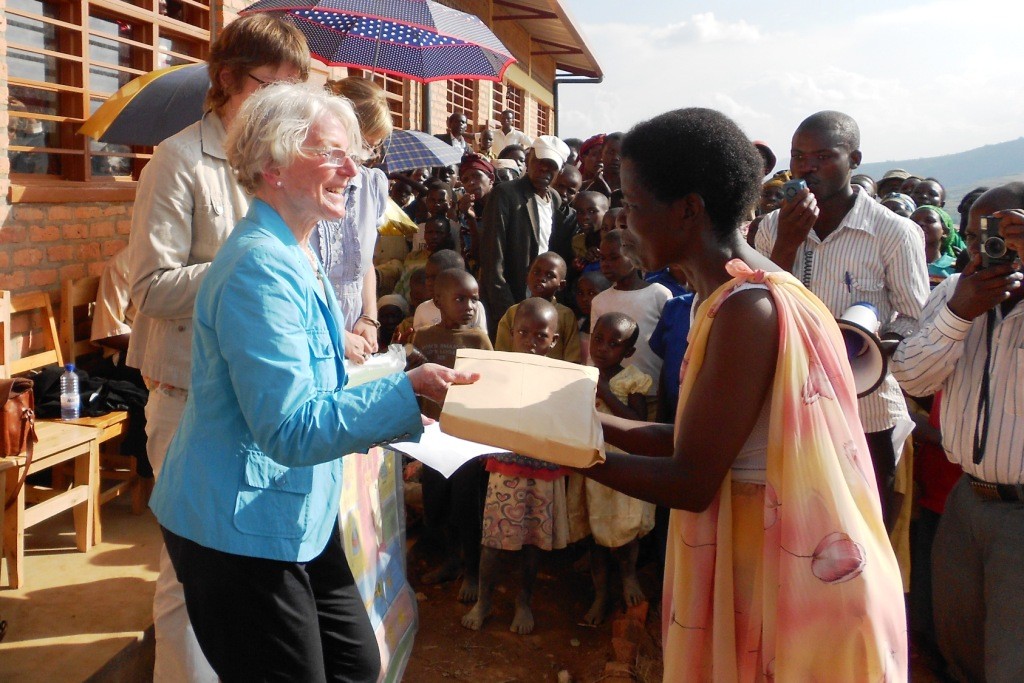
We mourn the loss of a remarkable woman who devoted over forty years of her life to voluntary work, achieving visible success for the people of Rwanda. Part of her motivation came from her own experiences. Born in Eger, then Sudetenland, she experienced a childhood full of deprivation and irregular schooling, as the schools in Karlsbad were used as sanatoriums for wounded soldiers during the Second World War. Like many other Germans, her family was expelled from Czechoslovakia, left with nothing and came to Ingolstadt. After marrying Erwin Eminger and giving birth to her son, she moved to Bad Kreuznach and devoted herself to her family. Her son worked in the diplomatic service – an incentive to visit him and get to know foreign countries and cultures.
She was able to see many countries while traveling with her husband and observe how direct aid was effective in less developed countries and where large projects achieved the opposite. The poorest, women and children in rural areas, often fall by the wayside.
After the state of Rhineland-Palatinate established a partnership with Rwanda in 1982, it was obvious for her to get involved because there were opportunities for action and scope for shaping relations between people here and there. She was also convinced by the idea of a “grassroots partnership,” where people in the North and South develop and implement projects together to give disadvantaged people the chance for a better future.
Elisabeth Eminger was one of the founding members of the Rwanda Committee e.V. Bad Kreuznach, established on November 14, 1983, and served as its treasurer from 1983 to 2014. She was the tireless driving force behind the association, to which she remained connected even after it was dissolved in 2018 (an informal circle of friends of the same name continues to work to this day). Determination, precision, dedication, and friendly tenacity were the hallmarks of her tireless commitment.
The Rwanda Committee was characterized by personnel consistency. Since its foundation, there have been only three chairpersons of the committee (Bernhard Jakob until 1986, Klaus Schmitt from 1986 to 1991, Karl Heil from 1991 to 2018), and Elisabeth Eminger as treasurer (who was replaced by Beate Wegmann in 2014). The treasurer played a key role in the association. Not only did she keep a close eye on the finances, but she also ensured that the coffers were well filled for various projects through numerous activities such as large charity events and many contacts with donors. It was a matter of honor that the projects, which were then developed in consultation with the Rwandan partners, were accounted for correctly, and that all the work of the board was done on a completely voluntary basis. To date, no administrative costs or personal expenses, e.g., for travel, have been reimbursed.
The committee focused particularly on children, young people, and schools. In the poor, rural region of Rwanda where the committee was active, there was a lack of many things. Schools were built and equipped with furniture, water pipes and spring taps were installed, and contributions were made to supply medical stations and hospitals: better basic care and the opportunity for children and young people to take their development into their own hands through a good school education. However, many families could hardly afford this, so support for gifted students was added in the form of school fees.
After the genocide in Rwanda in 1994, everything lay in ruins. The committee first provided emergency aid and then expanded its activities. Schools remained an essential part of the work, as did the establishment of school partnerships. In addition to the children, many women were living on the breadline. Elisabeth Eminger established two widows’ cooperatives, “Amizero” and “Abadateba,” which jointly organized their development with small livestock farming and microcredits.
The committee’s donations were irregular, intended for specific projects, and did not allow for continuous payments such as school fees. So, after the 1994 genocide, Elisabeth Eminger decided to establish a foundation independent of the committee. In 1996, the “Rwanda Education Aid Foundation” was established with what she once called “begged-for capital” of DM 50,000. Thanks to her tireless efforts, this later grew into a six-figure euro sum, the interest income, endowments, and donations from which enabled primary or secondary school education for orphans and other particularly needy children. Under her chairmanship, another success story of direct, sustainable development cooperation unfolded.
For her commitment to the partnership between Rhineland-Palatinate and Rwanda, Elisabeth Eminger was awarded the Federal Cross of Merit in 1999 and the Order of Merit of the State of Rhineland-Palatinate in 2004, among other honors. Her exemplary work can only be inadequately honored, even with this obituary. She will remain unforgotten in Rhineland-Palatinate and Rwanda.
Karl Heil, Rwanda Committee Bad Kreuznach, October 2025


